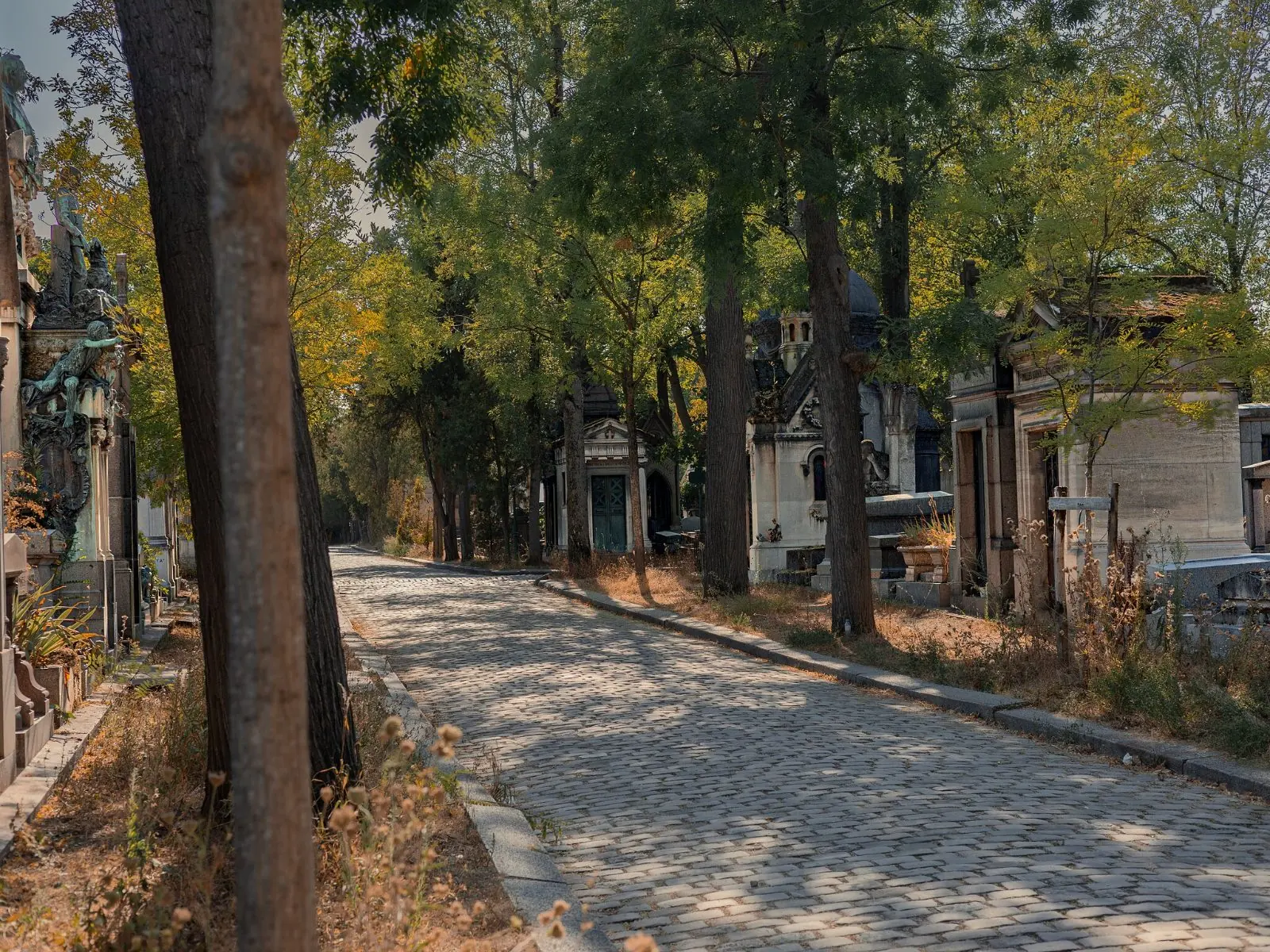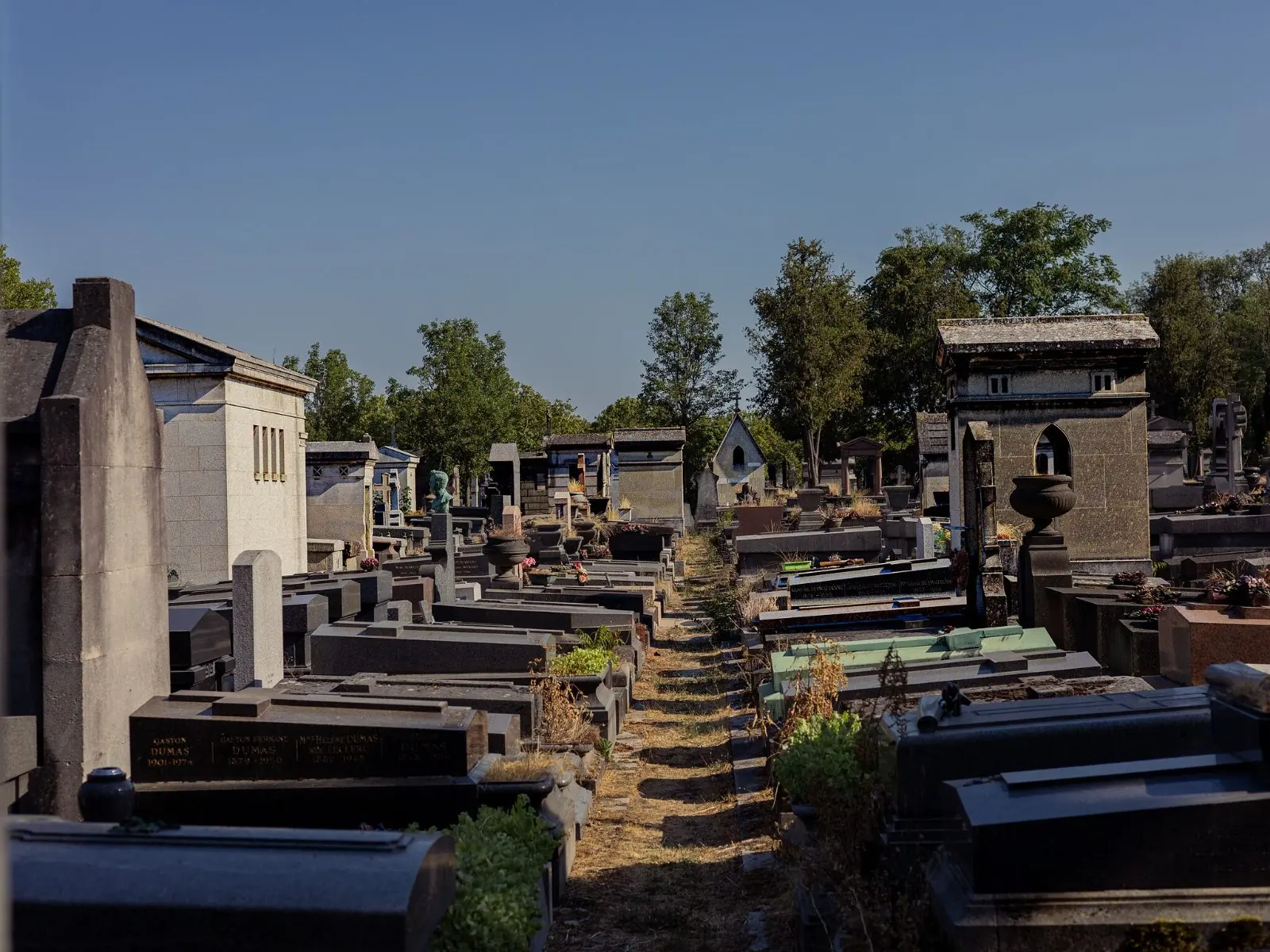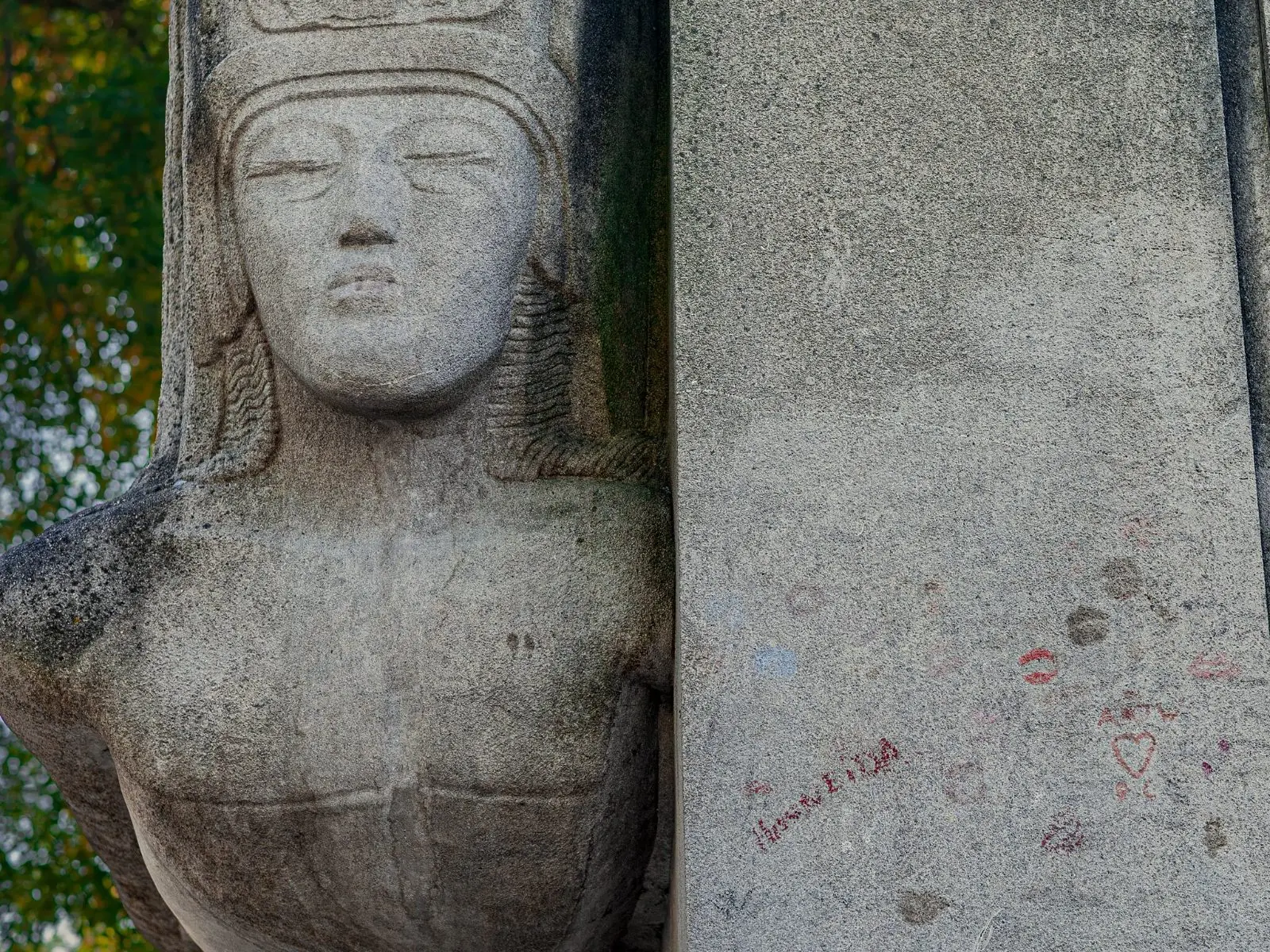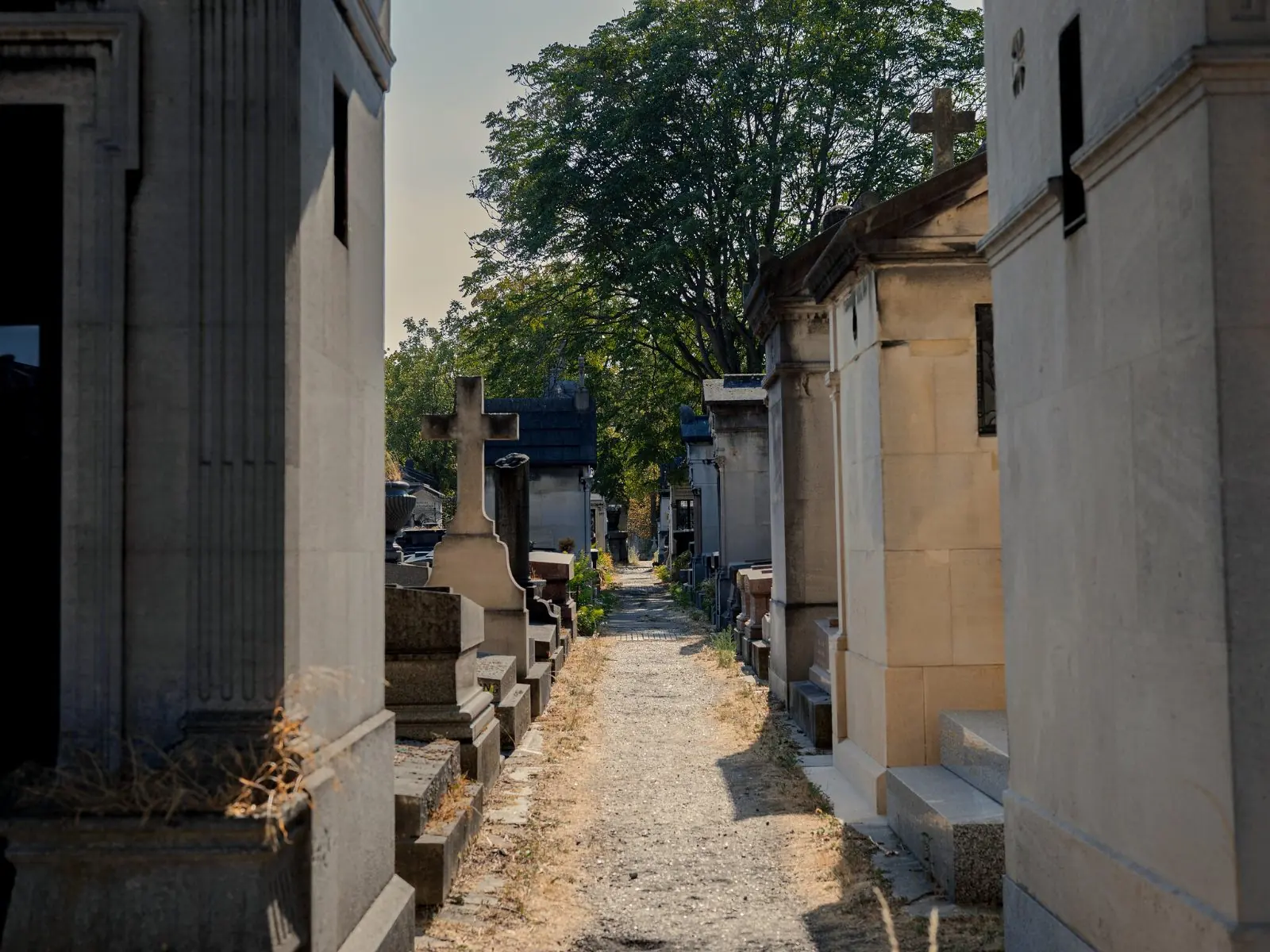
This is the route we would walk if we were not being paid to walk it, written out so you can do it on your own for nothing. Entry to Père Lachaise is free; so is this.
It takes about two hours at a reasonable pace with stops, covers about two and a half kilometres, and — this is the entire design principle — runs downhill from start to finish. You come in at the top of the hill and leave at the bottom, four minutes from the métro.
Copy the division numbers onto paper before you set off. The cemetery is signed by division and by nothing else, mobile signal is poor under the tree cover, and GPS is worse.
Before you start
Get off at Gambetta (métro lines 3 and 3bis), take the Place Gambetta exit, and walk down avenue du Père-Lachaise for about two hundred metres. Turn left into rue des Rondeaux; the Porte Gambetta is a hundred metres along on the right. Allow five minutes from the platform.
Check the closing time before you go in — 18:00 from 16 March to 5 November, 17:30 otherwise — and remember that clearing starts fifteen minutes earlier and works inward from the outlying gates. Start this route at least three hours before closing.
1. Division 97 — Édith Piaf, and the memorials
Straight in from the gate and bear left. The Gassion-Piaf grave is a flat black slab, usually under flowers. She is buried under her married name, with her father, her daughter Marcelle who died at two, and Théo Sarapo. Who else is under that stone.
Before you leave this division, look around you properly. Division 97 holds the memorials to the deportations, placed from 1949 onwards by survivors’ associations for the individual concentration camps and for the Resistance. They are the most demanding sculptures in the cemetery, and almost everyone who comes here for Piaf walks past them without registering that they are there. Give them ten minutes.
2. Division 96 — Modigliani
A short walk south-west. A modest stone shared with Jeanne Hébuterne, who died two days after he did and was moved here years later, once her family relented.
3. Division 94 — Gertrude Stein and Alice B. Toklas
A low block of granite. Stein on the front, Toklas on the reverse at her own instruction. Look for the misspelled birthplace — Allfghany — which nobody has ever corrected. Why Toklas is on the reverse.
4. Division 92 — Victor Noir
Downhill and east. Jules Dalou’s bronze of a twenty-one-year-old journalist shot dead by Napoleon III’s cousin in 1870, modelled flat on the slab as he fell, hat beside him. Parts of it are polished gold by visitors. Read why the politics are better than the superstition before you get there.
5. Division 89 — Oscar Wilde
North-west a short way. Jacob Epstein’s winged figure, twenty tonnes of Hopton Wood stone, behind glass since 2011. Walk round to the back for the stanza from The Ballad of Reading Gaol and for the small niche holding Robert Ross’s ashes. The whole story of Epstein’s commission.
6. Division 87 — the crematorium and columbarium
Below Wilde. Jean-Camille Formigé’s Byzantine-revival dome, the first crematorium in France, working from 1889. Go inside the columbarium if it is open; the corridors of named niches are one of the strangest spaces in Paris. Isadora Duncan is here, and Maria Callas’s memorial niche — her ashes were removed in 1979 and scattered in the Aegean.
7. Division 76 — the Mur des Fédérés
Follow the avenue Circulaire round to the eastern boundary. A plain stretch of wall, a plaque, and usually wreaths. On 28 May 1871, 147 Communards were shot against it and buried in a trench where they fell. It is the quietest stop on this walk and the one you will remember. What happened at the wall in May 1871.
8. Division 85 — Marcel Proust
Back west and slightly north. A rectangle of polished black marble with nothing on it, built for his father the public-health official and shared with his brother Robert, who got the last three volumes into print. Stand at the foot and look at the trees reflected in the stone. The brother buried with him.
While you are here, division 86 next door holds Guillaume Apollinaire, under a rough menhir-like stone cut to a design by Picasso.
9. Division 48 — Balzac
A long, pleasant descent. A bronze bust by David d’Angers on a fluted column. Victor Hugo gave the eulogy here in the rain in 1850. Climb a division or two above the grave and look west: this is the slope Balzac used for the last line of Le Père Goriot. Hugo’s eulogy, and the view Balzac wrote.
Division 49, next door, holds Delacroix under a severe black sarcophagus he specified himself.
10. Division 44 — Bernhardt, Kardec, Signoret and Montand
The densest division on the route. Sarah Bernhardt under a plain granite slab; Allan Kardec, who codified Spiritism, under a dolmen that receives more flowers than almost anything here; and Simone Signoret and Yves Montand together under one modest stone.
11. The Monument aux Morts
Down at the roundabout. Albert Bartholomé’s 1899 relief: a line of naked figures of every age walking into a plain doorway cut in the stone, with an ossuary of unnamed Parisians behind it. No religious iconography and no consolation offered.
This is the best sculpture in the cemetery. Most mornings you will have it to yourself.
12. Division 25 — Molière and La Fontaine
On the chemin Molière. Two matched sarcophagi raised on columns, moved here in 1817 to rescue a failing cemetery — a campaign that worked so completely that everything else on this walk is downstream of it. Whether the right remains are inside has never been settled. How the 1817 transfers rescued the cemetery.
13. Divisions 11, 7 and 6 — Chopin, Héloïse and Abélard, Morrison
The last three are within five minutes of each other and of the exit.
Chopin, division 11: Clésinger’s muse Euterpe weeping over a broken lyre, never without Polish flowers. His heart is in Warsaw. How his heart got to Warsaw.
Héloïse and Abélard, division 7: a neo-Gothic canopy assembled in 1817 out of salvaged abbey stonework by Alexandre Lenoir. Look at the mouldings where the joins do not run through. Camille Pissarro is in the same division.
Jim Morrison, division 6: a flat bronze plaque behind a railing, considerably smaller than you expect. Stay outside the railing; the graves either side belong to families who still visit. The myths worth retiring.
Then out through the main gate onto boulevard de Ménilmontant. Philippe Auguste (line 2) is a minute to your left; Père Lachaise (lines 2 and 3) is two minutes to your right and busier.
Two pieces of advice about doing it alone
Do not try to do all thirteen in ninety minutes. You will spend the whole walk looking at your list rather than at anything. If you are short of time, cut stops 2, 3 and 10 and take longer over what is left.
Then abandon the route. Walk twenty minutes in any direction with no destination. The best sculpture at Père Lachaise is almost never over a famous name — two hundred years of Parisian families commissioned monuments from working sculptors, and the anonymous divisions are full of things better than anything on this list. That twenty minutes is the part people remember.