Small-group walk
Père Lachaise Cemetery guided walking tour
Two hours on foot, downhill from the Gambetta gate to the boulevard, with about a dozen graves and the history that connects them.
- Duration
- 2 hours
- Group size
- Maximum 20 people
- Language
- English
- Meeting point
- Porte Gambetta, 55–57 rue des Rondeaux, 75020
- Price
- €19 per person
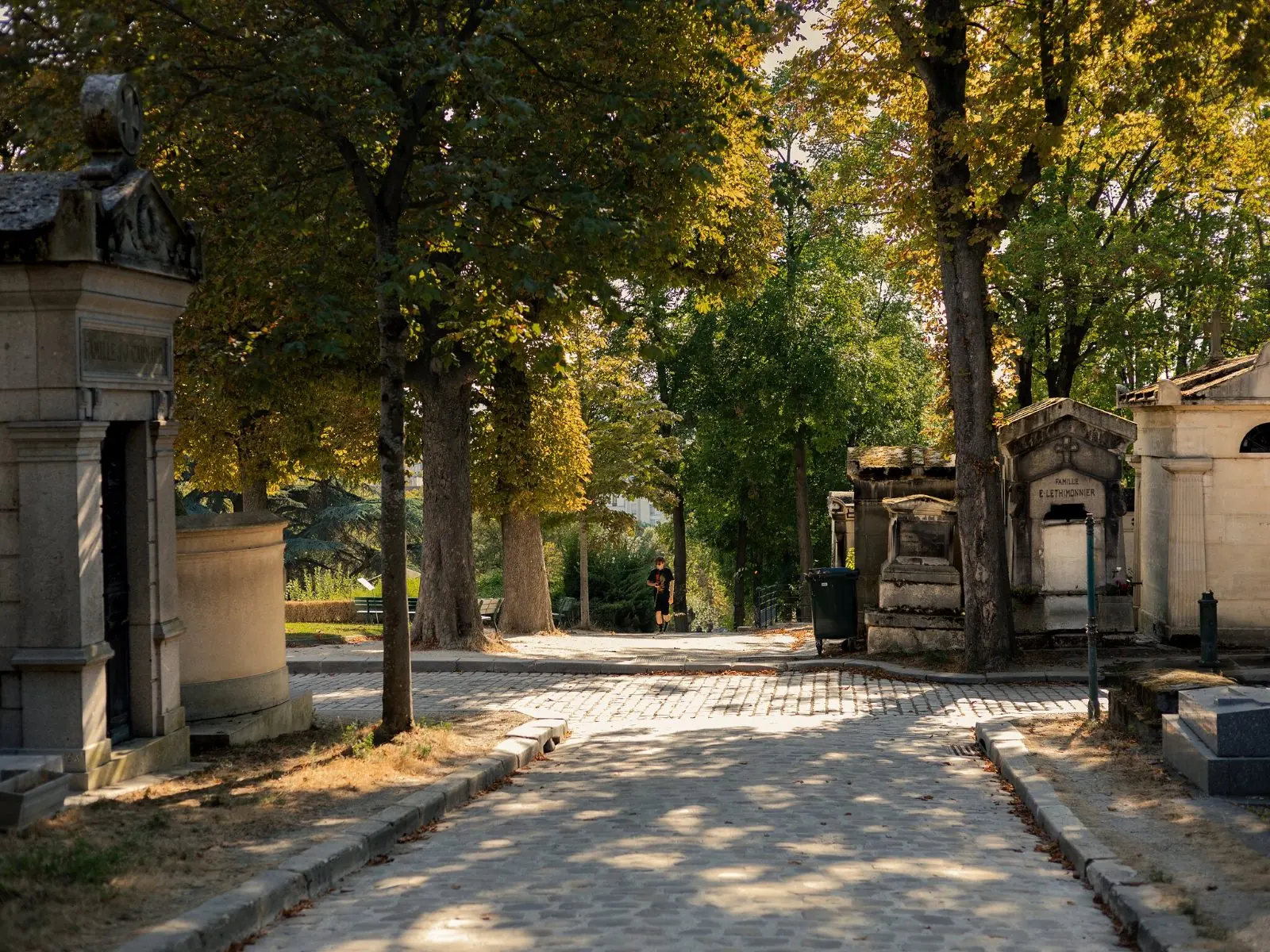
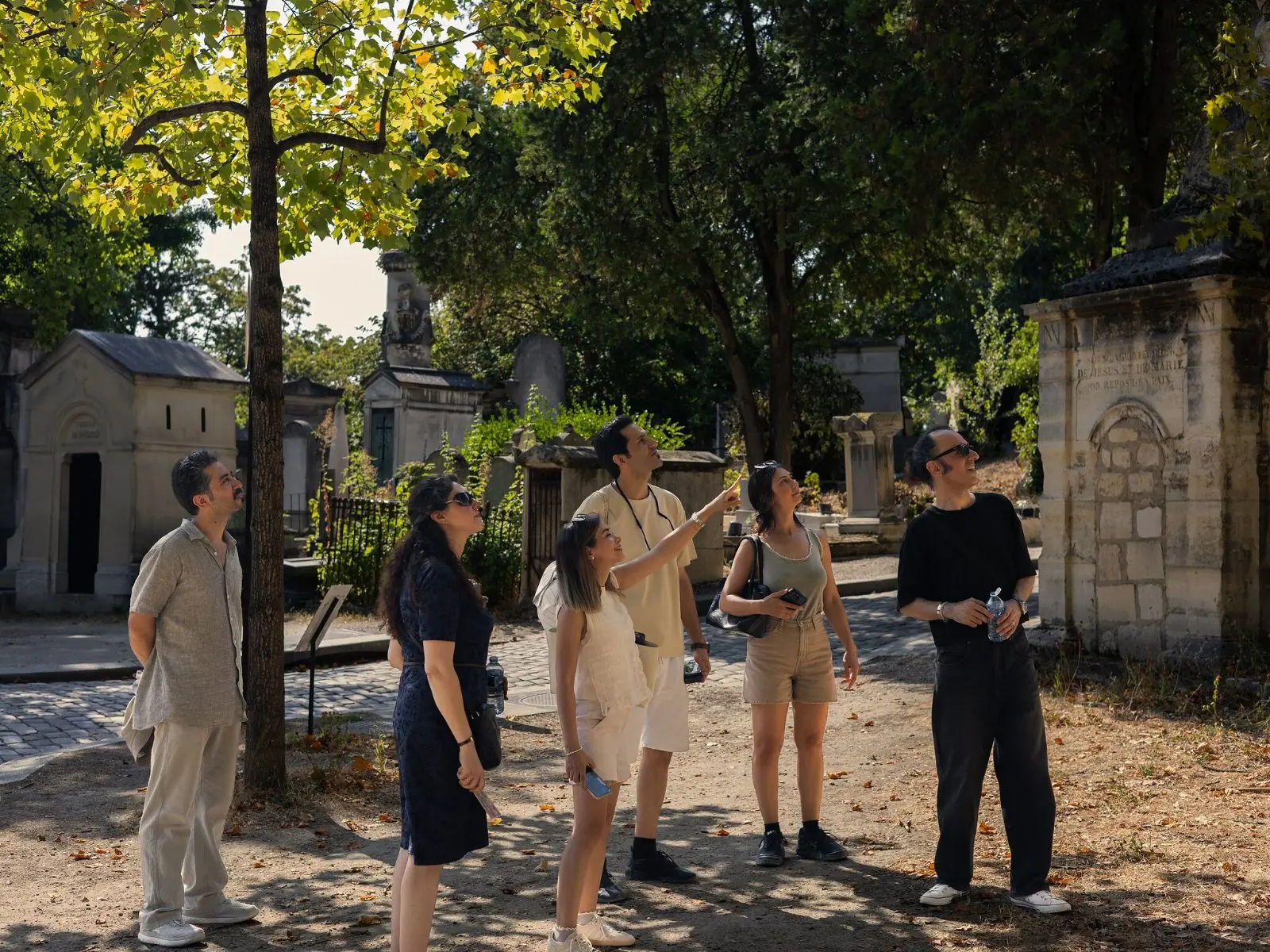
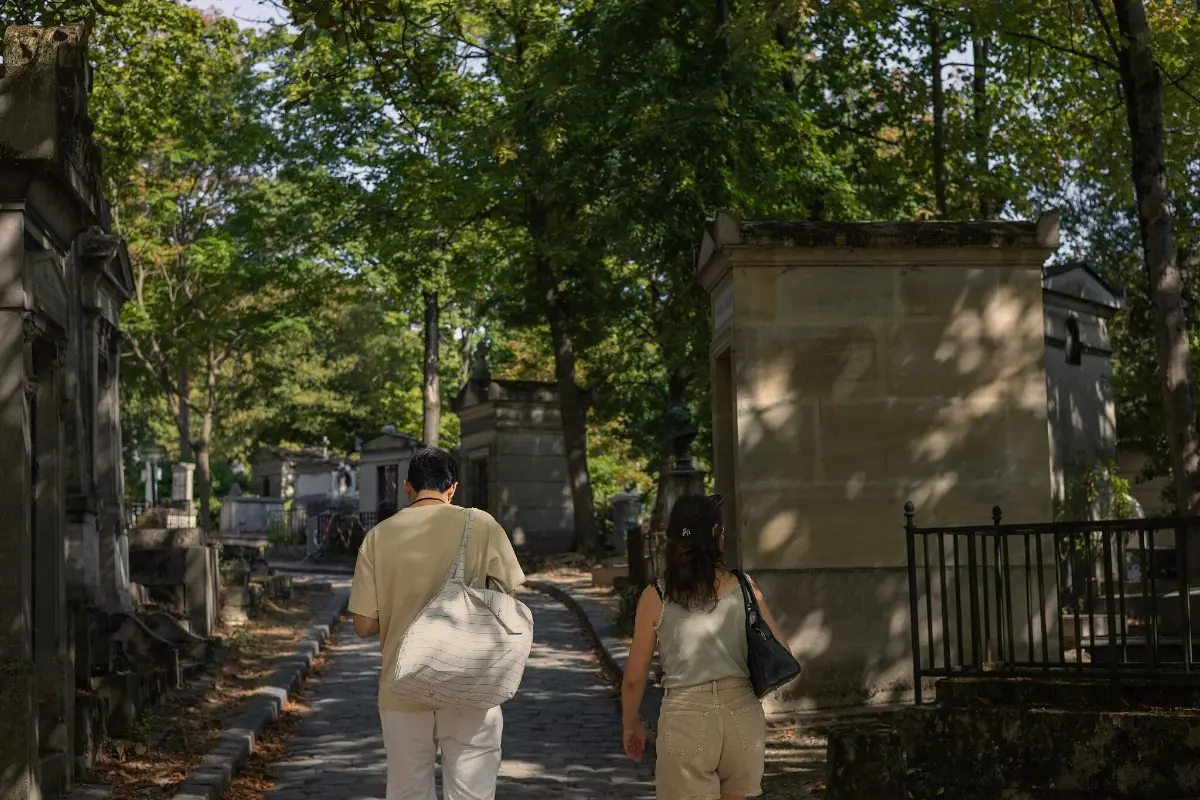
What you’ll see
The order below is the usual one. Guides adapt it for crowds, closures and the weather, and they will tell you when they do.
Meet at the Gambetta gate and start at the top
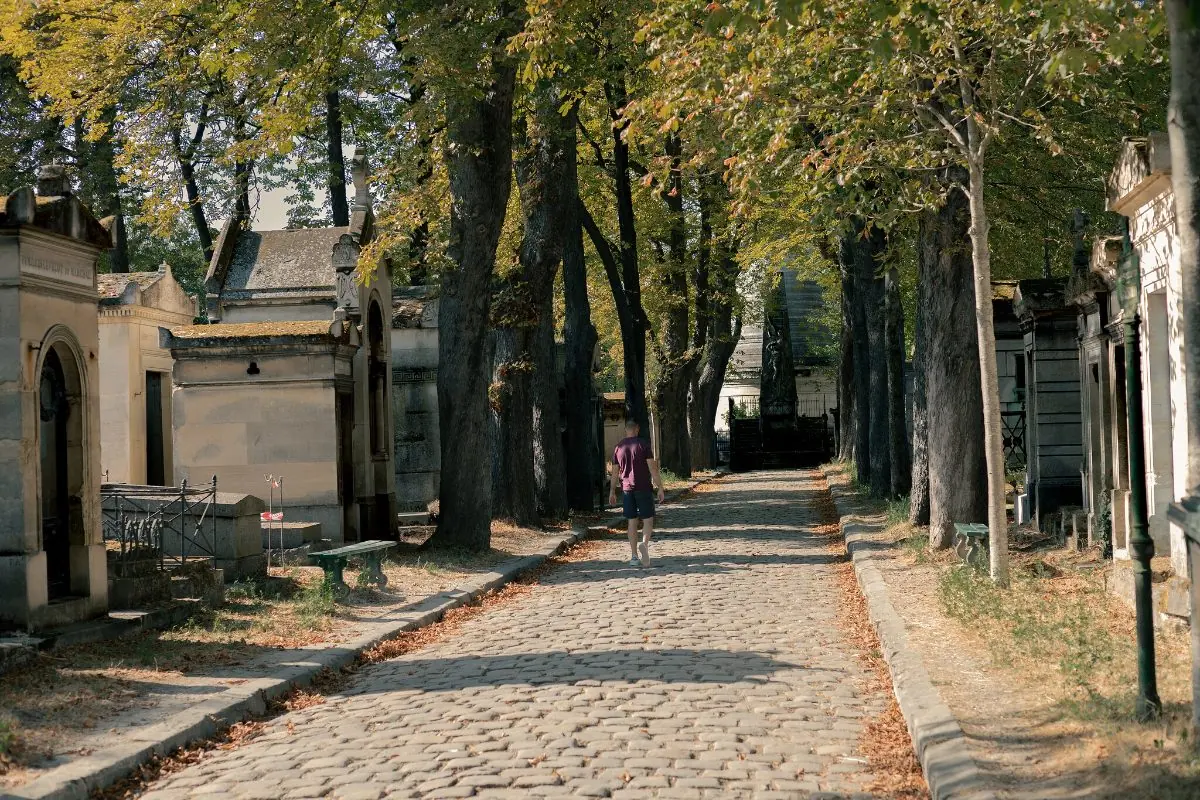
Almost everyone enters at the bottom, on boulevard de Ménilmontant, and then spends two hours climbing. We start at the Gambetta gate instead, at the highest corner of the cemetery, and walk downhill the whole way. It is the same route in reverse, and it is a completely different afternoon.
Édith PiafDivision 97
A small black granite slab, usually with fresh flowers on it. Piaf is buried here with her father Louis Gassion, her daughter Marcelle — who died at two — and her second husband Théo Sarapo. We talk about the Belleville streets a few minutes' walk from this spot, and about the funeral in 1963 that stopped Paris traffic.
Gertrude Stein and Alice B. ToklasDivision 94
A plain headstone, and the detail most visitors miss: Toklas's name is carved on the back, at her own request, so that Stein's face remained the front. Thirty-nine years of a life together, arranged in stone as a footnote.
Oscar WildeDivision 89
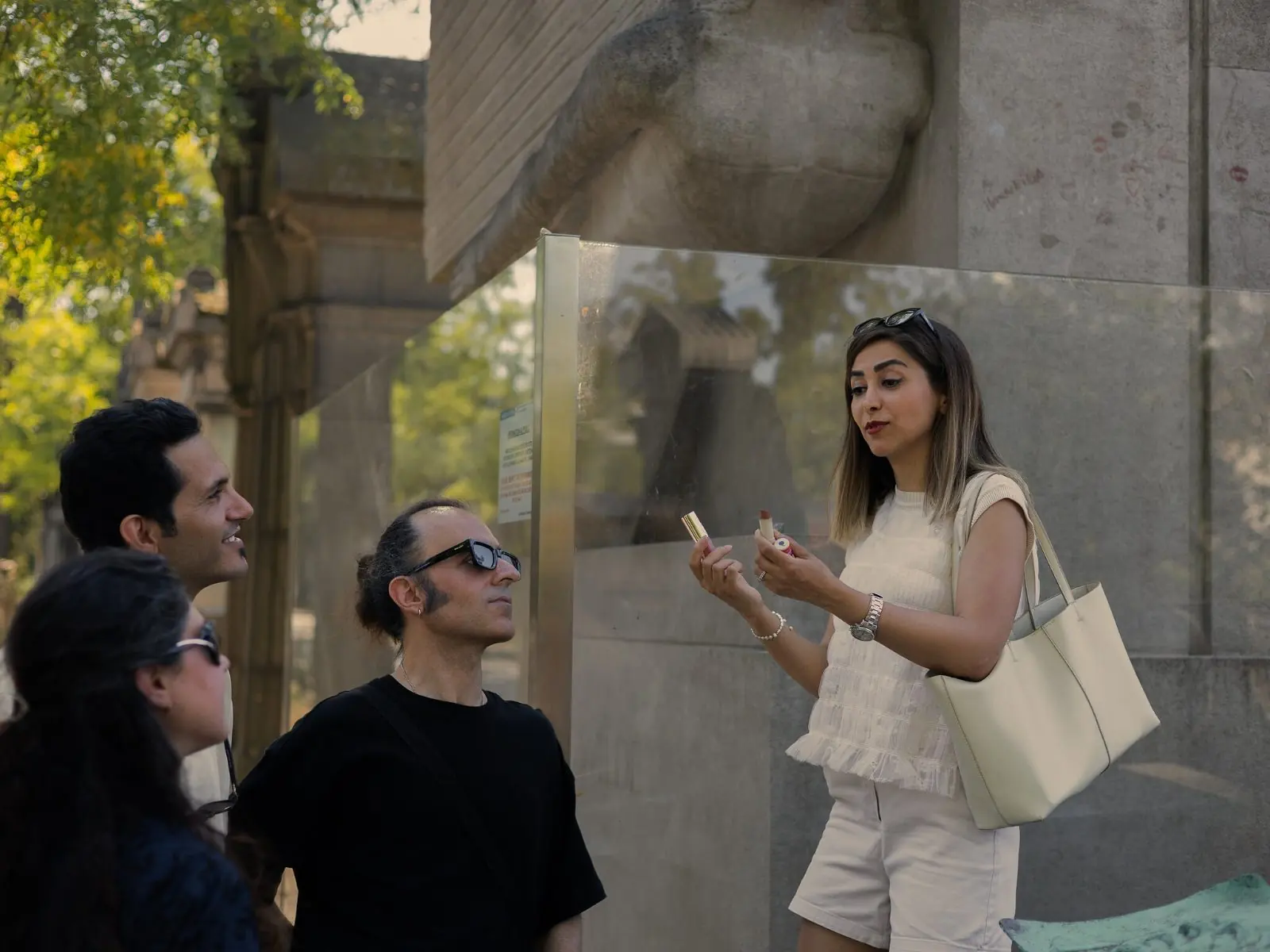
Jacob Epstein's enormous winged figure, cut from a single block of Hopton Wood stone and installed in 1914. It scandalised the cemetery authorities, was tarpaulined for months, and has since been kissed, scrubbed and finally glazed. The glass barrier went up in 2011. We explain who paid for the tomb, why the kissing had to stop, and what the lipstick was actually doing to the stone.
The crematorium and columbariumDivision 87
Jean-Camille Formigé's Byzantine-revival dome, the first crematorium in France. Cremation was legalised here in 1887 against considerable opposition, and the building was designed to make an unfamiliar practice look like a cathedral. Maria Callas's ashes were held in this columbarium before they were scattered in the Aegean.
Victor NoirDivision 92
Jules Dalou's 1891 bronze of a 21-year-old journalist shot dead by Napoleon's cousin. It is the most polished bronze in Paris, for reasons the statue makes obvious, and the story of why 100,000 people turned up to his funeral is a better one than the story of the superstition.
The Mur des FédérésDivision 76
A plain stretch of wall at the eastern boundary. On 28 May 1871, at the end of the Semaine sanglante, 147 Communards were shot against it and buried in a trench where they fell. This is the quietest stop on the walk and usually the one people remember.
Marcel ProustDivision 85
Black marble, polished, almost aggressively plain — the family tomb, with his brother Robert, who edited the last volumes into print, and his parents. Proust spent the final years of his life in a cork-lined room a twenty-minute walk from here.
Honoré de BalzacDivision 48
David d'Angers's bust on a column, and the funeral at which Victor Hugo gave the graveside speech in driving rain. Balzac had walked these paths before he was buried in them: he put his own characters in this cemetery, and Rastignac's challenge to Paris is delivered from the slope just above us.
The Monument aux Morts
Albert Bartholomé's 1899 relief, carved after his wife's death, of a line of figures walking into a doorway in the stone. Behind it is an ossuary holding the remains of Parisians whose names are gone. It is the piece of sculpture here that most repays standing still in front of.
Molière and Jean de La FontaineDivision 25
The two sarcophagi that made this cemetery's reputation. In 1817 the administration moved them here with a great deal of ceremony, and plot sales went from a trickle to a flood. Whether the bones inside are actually theirs is a question historians have never resolved, and we say so.
Frédéric ChopinDivision 11
Clésinger's weeping muse, Euterpe, over a grave that is almost always covered in Polish flowers and ribbons. Chopin's body is here; his heart is in a pillar of the Holy Cross Church in Warsaw, smuggled out of France in a jar by his sister. We explain how that happened.
Héloïse and AbélardDivision 7
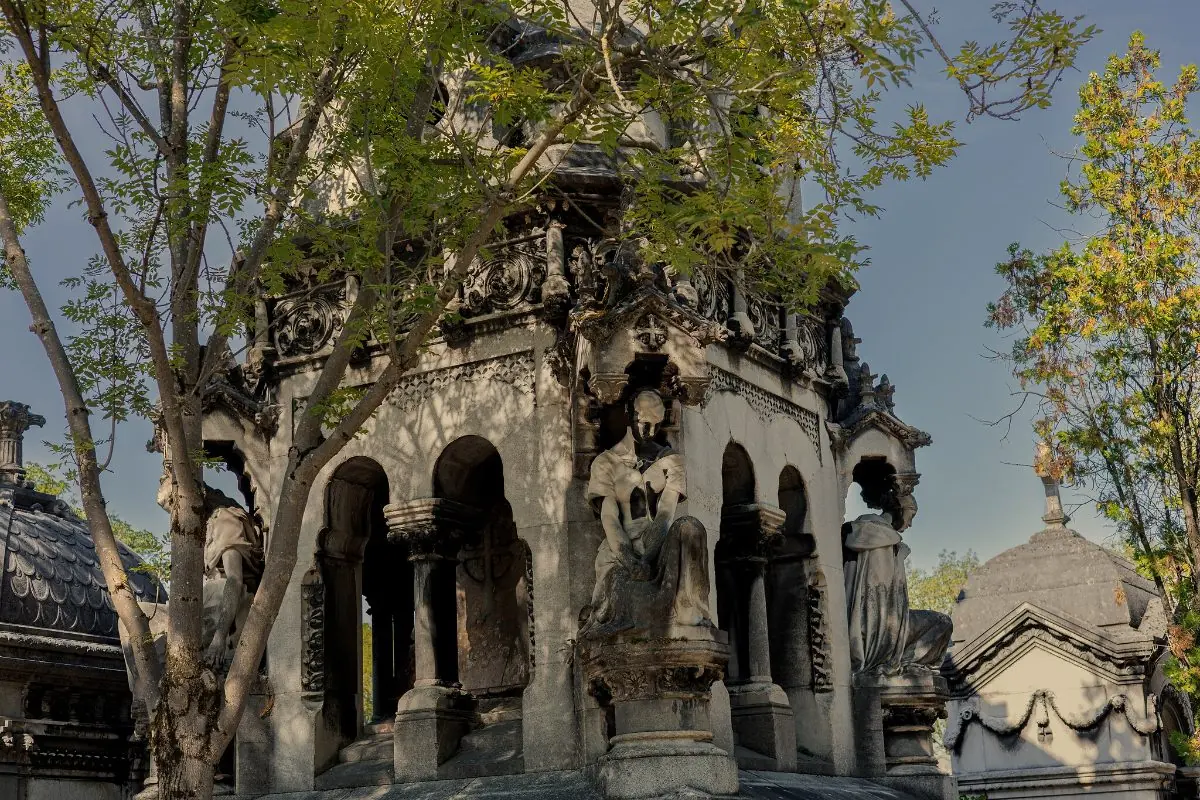
A neo-Gothic canopy assembled in 1817 from fragments of the abbey where Héloïse was prioress. Whether the couple beneath it are the couple named on it is, again, unresolved — but the monument did exactly what the cemetery needed it to do.
Jim Morrison, and out through the main gateDivision 6
A modest flat stone with a Greek inscription his father chose, behind a low barrier, a few minutes from the exit. We finish here, deal with the myths, and put you out onto boulevard de Ménilmontant two minutes from the métro.
What's included
- A licensed guide for two hours
- A group capped at twenty, so you can hear without straining
- A printed division map to keep, marked with everything we passed and everything we did not have time for
- Answers to whatever you ask, including the questions the plaques do not cover
What's not
- Cemetery admission — there is none. Entry is free for everyone, every day
- Transport to the meeting point
- Food and drink (there is nowhere inside to buy either)
- Hotel pick-up
Where we meet
Porte Gambetta, 55–57 rue des Rondeaux, 75020. Your guide will be just inside the gate with a small sign. Please arrive ten minutes early: we start on time because the cemetery closes on time.
- From métro Gambetta (lines 3 and 3bis)
- Take the exit marked Place Gambetta / Avenue du Père-Lachaise. Walk down avenue du Père-Lachaise for about 200 metres with the square behind you, then turn left into rue des Rondeaux. The Gambetta gate is 100 metres along on your right. Allow five minutes from the platform.
- From métro Père Lachaise (lines 2 and 3)
- This is the wrong end for our walk — it is the bottom of the hill. Stay on line 3 one more stop to Gambetta rather than walking up through the cemetery, which takes twenty minutes and rather spoils the order of things.
- From bus 26, 60, 61, 64, 69 or 71
- All of these stop within a few minutes of the cemetery. For the Gambetta gate, the 26 and 60 to Place Gambetta are the most direct.
- By taxi
- Ask for 55 rue des Rondeaux, 75020. Do not ask for Père Lachaise — you will be taken to the main gate on the boulevard, a twenty-five-minute walk away.
Accessibility, honestly
- This walk is not suitable for wheelchairs or for anyone who cannot manage uneven ground. The City of Paris describes the cemetery's paths as old cobbles and packed earth, irregular and in places very narrow, and that is accurate.
- We cover roughly 2.5 kilometres, almost all of it downhill, with several short flights of steps that cannot be avoided on this route.
- There is no seating on most of the route and no shelter if it rains.
- If steps are the problem but distance is not, ask us — a private walk can be routed along the surfaced main avenues instead, and we will tell you honestly what that route misses.
- Assistance dogs are welcome. Other dogs are not permitted in the cemetery.
More detail on the terrain, the gradients and which gates have steps is on our page about getting there and getting around.
Cancellation
- Free cancellation up to 24 hours before the start time, for a full refund.
- Inside 24 hours we cannot refund, because the guide has already been paid and the group has already been closed.
- We walk in rain. We do not walk in high winds, when the City of Paris closes the cemetery for safety — if that happens you are moved to another date or refunded in full, your choice.
- If fewer than three people book, we may cancel and refund in full, and we will tell you at least 24 hours ahead.
Your guide
Every walk is led by a guide who holds the French carte professionnelle de guide-conférencier — the state qualification that permits professional guiding in France. Guide biographies will be published here once the team is confirmed.
Questions about this walk
Do I need a ticket to get into Père Lachaise?
How much walking is involved?
Where exactly do we meet?
What happens if it rains?
Is the tour suitable for children?
Can we visit a specific grave?
Is the cemetery still in use?
How far ahead should I book?
€19 per person
Book now