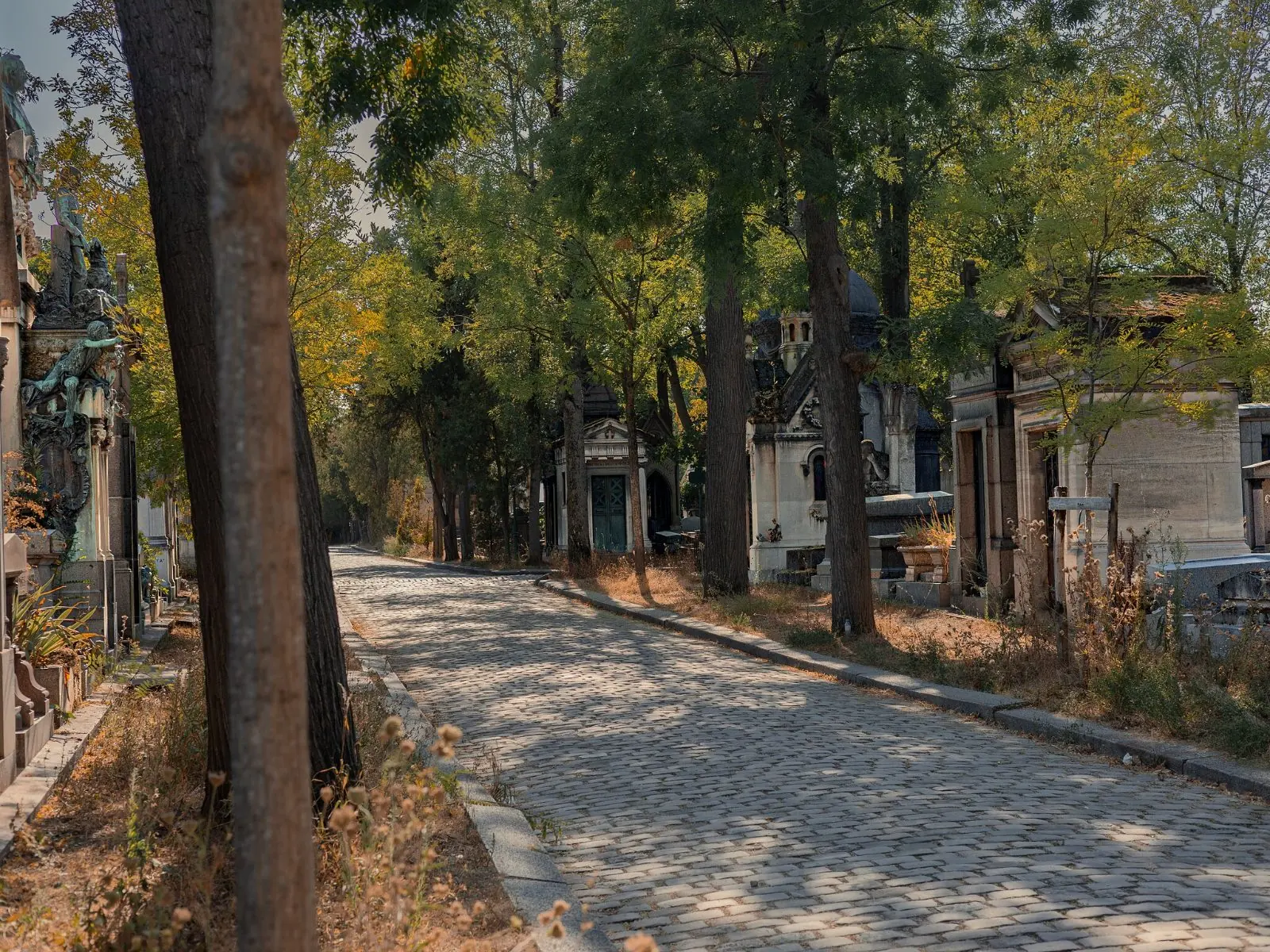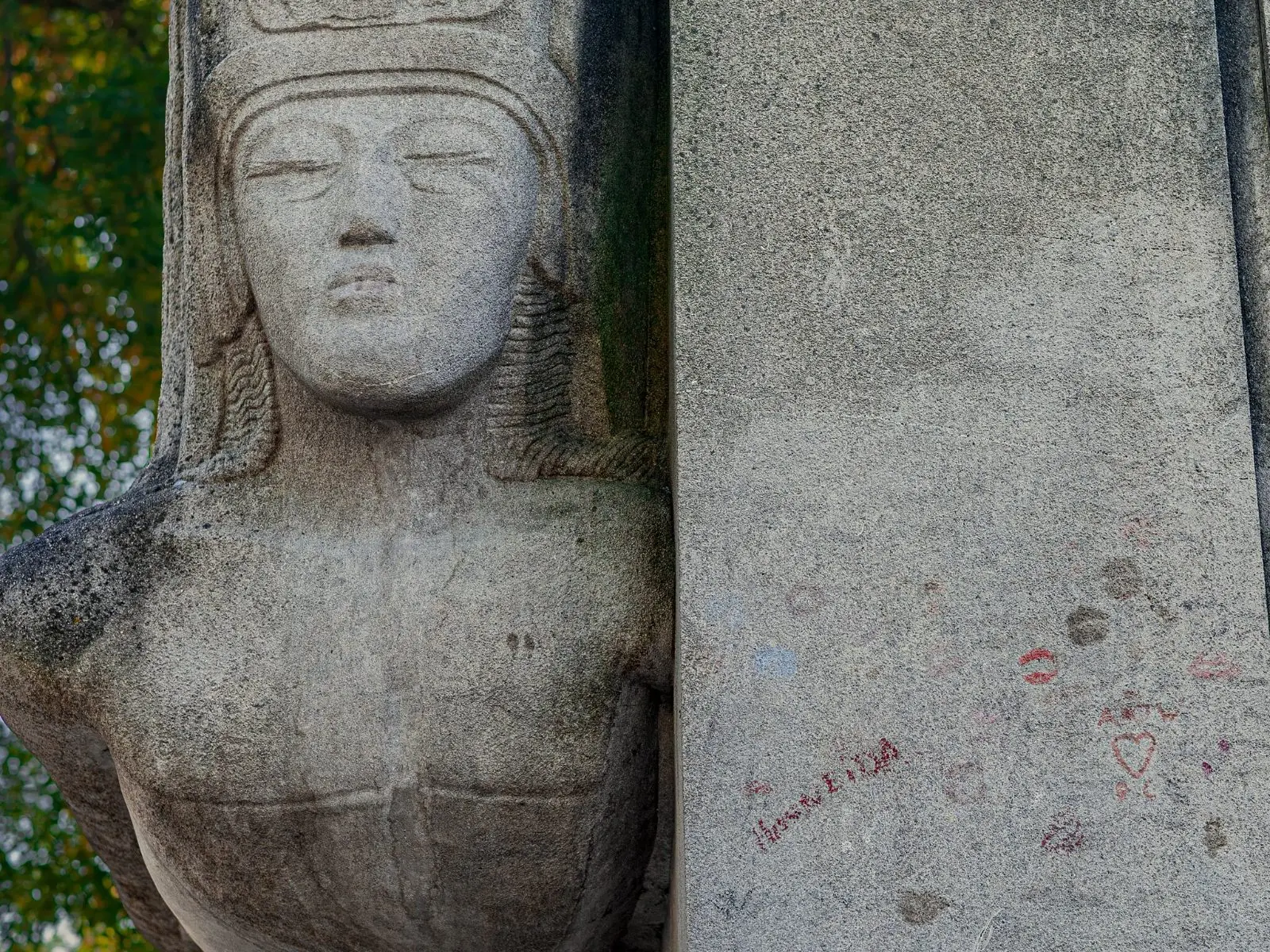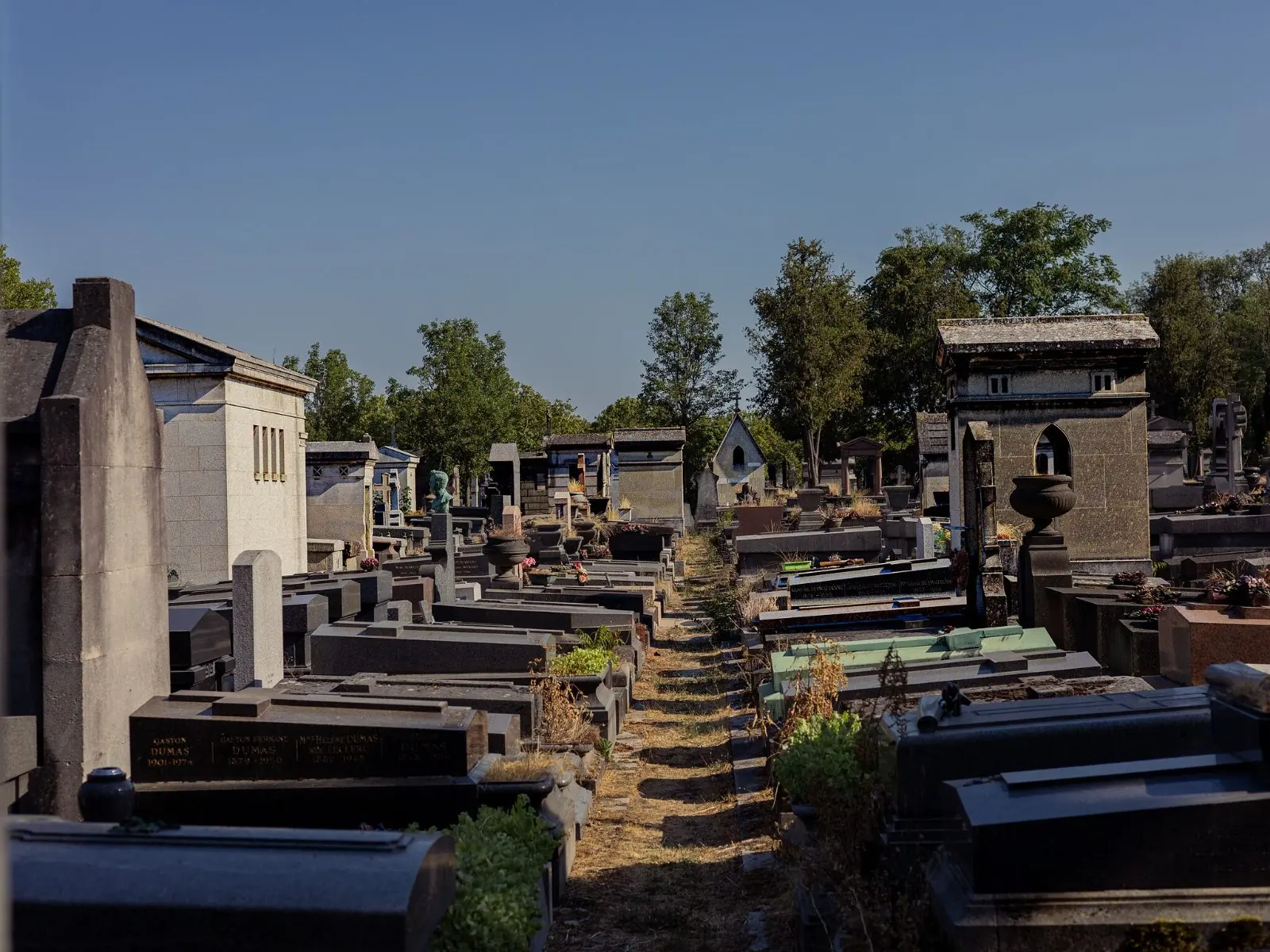
The cemetery is signed by division number and by nothing else. There are no signposts to individual graves. So the useful version of this list is not twenty names — it is twenty numbers, in an order that works on the ground.
Everything below has been cross-checked against at least two independent sources. Wrong division numbers are the most-repeated error on the English-language web about Père Lachaise, and they cost people whole afternoons.
The order to walk them in
Start at the Porte Gambetta and go downhill. The list below is roughly in that order, not in order of fame. It ends four minutes from the main gate and the métro.
1. Édith Piaf — division 97
A flat black granite slab, usually banked with flowers, six minutes inside the Gambetta gate. She is buried as Madame Lamboukas dite Édith Piaf — under her second husband’s surname — with her father, her daughter Marcelle who died at two in 1935, and Théo Sarapo. Forty thousand people came to the funeral in 1963 and Paris traffic stopped. The full entry is here.
2. The deportation memorials — division 97
Not a grave, and the reason to linger in this division. A group of sculptures placed from 1949 onwards by survivors’ associations, commemorating individual concentration camps and the French Resistance. They are the most demanding things in this cemetery and almost nobody looking for Piaf notices they are standing among them.
3. Amedeo Modigliani — division 96
A modest stone. He died in January 1920 at thirty-five; Jeanne Hébuterne, nine months pregnant, killed herself two days later. Her family buried her elsewhere and only years afterwards consented to move her here, to the same grave.
4. Gertrude Stein and Alice B. Toklas — division 94
One low block of granite, designed by the painter Francis Rose. Stein on the front; Toklas on the reverse, at her own request, twenty-one years later. The stone also misspells Stein’s birthplace as “Allfghany”, and nobody has ever corrected it. More here.
5. Victor Noir — division 92
Jules Dalou’s bronze of a twenty-one-year-old journalist shot dead by Napoleon III’s cousin in 1870, modelled as he fell — flat on the slab, hat beside him. Parts of it are polished bright for reasons the sculpture makes obvious. The politics behind it are better than the superstition.
6. Oscar Wilde — division 89
Jacob Epstein’s winged figure, carved 1909–1912 from a single twenty-tonne block, tarpaulined by the authorities as indecent, unveiled in 1914 and enclosed in glass since 2011 because lipstick was eating the stone. Robert Ross’s ashes are in the plinth. Full entry.
7. Guillaume Apollinaire — division 86
A rough menhir-like stone cut to a design by Picasso, carrying one of the poet’s own calligrammes. He died of Spanish flu in November 1918, two days before the Armistice, weakened by a head wound from the Front.
8. Marcel Proust — division 85
A rectangle of polished black marble with nothing on it. It was built for his father, a distinguished public-health official, and Proust was added to it. His brother Robert, also here, is the reason the last three volumes exist in print. Full entry.
9. The crematorium and columbarium — division 87
Jean-Camille Formigé’s Byzantine-revival dome, the first crematorium built in France, operating from 1889. Maria Callas’s ashes were held in the columbarium here before they were removed in 1979 and scattered in the Aegean; the niche is a memorial only. Isadora Duncan is a few steps away.
10. The Mur des Fédérés — division 76
A plain stretch of wall at the eastern boundary. On 28 May 1871, 147 Communards were shot against it and buried in a trench where they fell. It has been a site of political pilgrimage ever since, and it is the quietest stop on any route through this cemetery.
11. Georges Seurat — division 66
In the family vault, dead at thirty-one of an infection nobody has since identified with confidence. His son died of the same thing days later.
12. Georges Méliès — division 64
A bust of the film-maker who made Le Voyage dans la Lune in 1902, went bankrupt, burned his own negatives, and was discovered in the 1920s selling toys and sweets from a kiosk at the Gare Montparnasse.
13. Jacques-Louis David — division 56
Only his heart. David voted for the execution of Louis XVI, was exiled after Waterloo, and died in Brussels in 1825; the Belgian authorities refused to release the body, so the heart came home alone.
14. Eugène Delacroix — division 49
A severe black sarcophagus, modelled at his own instruction on a Roman tomb, with no sculpture and no allegory. From the painter of Liberty Leading the People, the restraint is the statement.
15. Honoré de Balzac — division 48
A bronze bust by David d’Angers on a fluted column. Victor Hugo gave the eulogy here in driving rain in August 1850. Balzac is buried on the exact slope he used for the last scene of Le Père Goriot, where Rastignac looks down at Paris and says À nous deux maintenant. Full entry.
16. Sarah Bernhardt, Allan Kardec, Signoret and Montand — division 44
The most concentrated division in the cemetery. Bernhardt lies under a plain granite slab entirely at odds with her life. Allan Kardec, who codified Spiritism, is under a dolmen that receives more flowers than almost any grave here. Simone Signoret and Yves Montand are together under one modest stone a few paces away.
17. The Monument aux Morts — the main roundabout
Albert Bartholomé’s 1899 relief: a line of naked figures of every age walking into a plain doorway cut in the stone, with an ossuary of unnamed Parisians behind it. No religious iconography, no consolation. It is the best sculpture in the cemetery and it is free of visitors most mornings.
18. Molière and Jean de La Fontaine — division 25
Two matched sarcophagi raised on columns, transferred here in 1817 as a marketing campaign that saved a failing cemetery. Whether the remains inside are theirs has never been settled, and we say so. Full entry.
19. Frédéric Chopin — division 11
Clésinger’s muse Euterpe, weeping over a lyre with a broken string, above a grave that is never without Polish flowers. His body is here; his heart is sealed in a pillar of a church in Warsaw, carried out of France by his sister. Full entry.
20. Héloïse and Abélard — division 7, and Jim Morrison — division 6
The last two, both within five minutes of the exit. The neo-Gothic canopy over Héloïse and Abélard was assembled in 1817 from salvaged abbey stonework by Alexandre Lenoir — the oldest-looking monument here and one of the newest arrivals. Camille Pissarro is in the same division.
And then Morrison: a flat bronze plaque his father placed in 1990, behind a low barrier, considerably smaller than anyone expects. The myths are dealt with here.
Nine more, if you have longer
Colette (4), Baron Haussmann (4), Félix Faure (4), Théodore Géricault (12), Auguste Comte (17), Jean-François Champollion (18), Camille Pissarro (7), Isadora Duncan (87, columbarium), and Maria Callas’s memorial niche (87).
One thing worth saying
The best sculpture at Père Lachaise is almost never over a famous name. Two hundred years of Parisian families commissioned monuments from working sculptors, and the anonymous divisions are full of things — a weeping figure, a broken column, a bronze door left ajar — that are better than anything above.
Walk the list, then put it away and wander for twenty minutes. That is the part people remember.