In its first year of operation, 1804, the new Cimetière de l’Est on the hill of Mont-Louis received thirteen burials. It had room for tens of thousands.
Thirteen years later the city moved the remains of Molière and Jean de La Fontaine into it with a public ceremony, and within a generation it was the most fashionable address for death in Europe. Every famous grave you will visit there — Chopin, Balzac, Wilde, Piaf, Morrison — is downstream of an administrative decision taken in 1817 to solve a budget problem.
The problem
Napoleon’s decree of 12 June 1804 had banned burial inside Paris and inside churches, ending a thousand years of practice. It was a public-health measure and an overdue one: the Cimetière des Saints-Innocents in the middle of the city had been taking bodies for six centuries, the ground had risen metres above the surrounding streets, and in 1780 a cellar wall on the rue de la Lingerie had collapsed under the weight of the mass grave behind it.
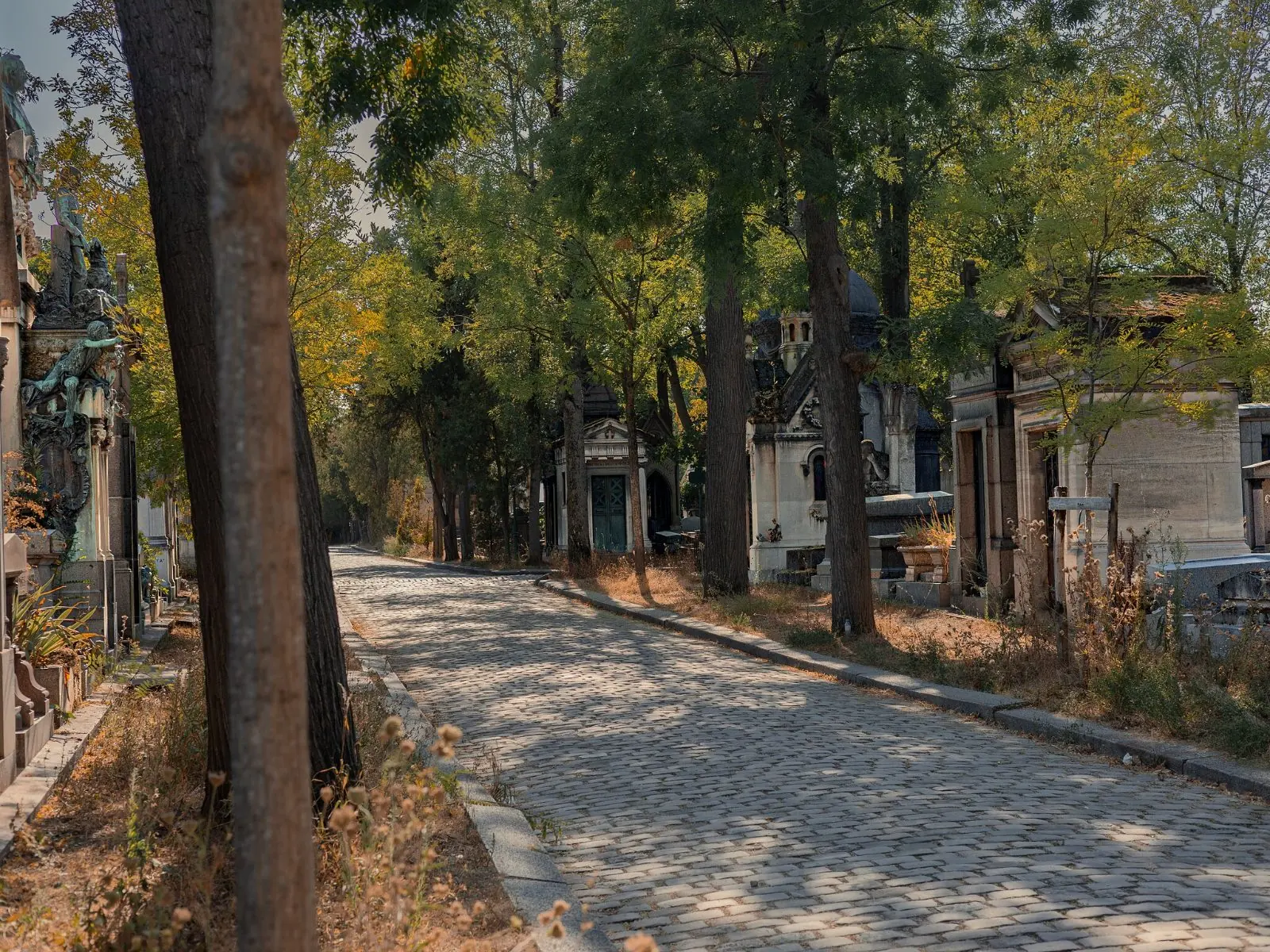
So the city bought a hillside estate east of the walls and commissioned Alexandre-Théodore Brongniart, architect of the Bourse, to lay it out. He designed something genuinely new: not a walled churchyard but an English landscape garden — winding paths following the contours, planted trees, framed views, an ascent to a high point — with graves in it.
And Parisians would not go near it.
The objections were reasonable enough at the time. It was a long way outside the city, in a district associated with nothing in particular. It was not attached to a parish and was not, in the way people expected, consecrated. It was in the east, and the east was poor. It was, above all, unfamiliar — a garden was not what a burial ground looked like.
By 1812 the cemetery held a few thousand graves across forty-four hectares. The city was carrying the cost of a large piece of landscaped ground that almost nobody wanted.
The solution
The prefecture’s answer was not to reduce prices or to consecrate the ground more thoroughly. It was to move in some famous corpses.
In 1817 the administration organised the transfer of the remains identified as Molière and Jean de La Fontaine. They were brought across Paris with public ceremony, and installed in matching raised sarcophagi — deliberately matched, deliberately elevated on columns, deliberately sited on a prominent path where they could be seen from a distance by people who had come specifically to look.
In the same period the monument to Héloïse and Abélard was installed nearby: a neo-Gothic canopy that the archaeologist Alexandre Lenoir had assembled from stonework salvaged from the abbey of the Paraclete and other suppressed foundations.
Read as a campaign, the selection is almost too neat. Molière and La Fontaine cover national literary prestige — the two most quotable Frenchmen of the grand siècle. Héloïse and Abélard cover romance, and specifically the kind of romance that draws visitors and letters. Between them they gave the cemetery a reason to be visited by people who were not attending a funeral, which is precisely the thing a burial ground on the far side of the city needed.
How well it worked
Immediately, and enormously.
Buying a plot at Père Lachaise stopped being a practical question about where to put a relative. It became a social statement: a declaration that your family belonged in the company of Molière. Plot sales went from a trickle to a flood.
By 1830 there were more than thirty-three thousand graves. The cemetery was extended five times over the following decades, which is why the division numbers run chronologically outward from the original core rather than in any geographical order — a detail that still confuses visitors and is explained on our map page.
The line of famous arrivals follows directly: Chopin in 1849, Balzac in 1850, Delacroix in 1863, and eventually Wilde transferred in from a suburban grave in 1909 precisely because Père Lachaise was the address that mattered.
It is, viewed coldly, the most successful destination-marketing campaign in the history of the funeral industry, executed by a municipal administration in 1817, and the mechanism is one every tourism board would recognise: acquire an anchor attraction, publicise the acquisition, and let the association do the rest.
The model spreads
The other consequence of 1817 is that it proved the idea, and the idea travelled.
Brongniart’s garden cemetery had been an experiment; a garden cemetery that was also a visitor attraction was a business case. Within twenty years the pattern had been exported wholesale. Mount Auburn opened outside Boston in 1831, explicitly modelled on Père Lachaise and explicitly intended to be walked in. Highgate followed in London in 1839, and the rest of the so-called Magnificent Seven behind it. Glasgow’s Necropolis, Vienna’s Zentralfriedhof, Buenos Aires’ Recoleta — all of them are variations on a hillside outside Paris.
Every one of them also inherited the second half of the formula. Highgate has Marx; Recoleta has Eva Perón; Mount Auburn spent its early decades publicising which eminent Bostonians had chosen it. The garden cemetery and the celebrity grave arrived together, and they arrived because of what happened in division 25 in 1817.
But is it them?
Almost certainly not, or at least not verifiably, and it is worth being straight about this because a great many accounts are not.
Molière died in February 1673, hours after playing the title role in Le Malade imaginaire. Actors were excommunicate under French practice and denied Christian burial; his widow had to petition Louis XIV directly. The compromise was a night burial in the Saint-Joseph cemetery, in ground reserved for unbaptised infants, without a service and without a marked grave. During the Revolution, remains identified as his were exhumed and taken to Lenoir’s Musée des monuments français.
La Fontaine died in 1695 and was buried at the Saints-Innocents — the same overcrowded cemetery that was closed and emptied wholesale into the catacombs in the 1780s. Remains identified as his went the same route through Lenoir.
Neither exhumation met anything a modern archaeologist would recognise as a standard. The 1790s were not a careful decade, the graves were not well marked, and the identifications were traditional rather than evidential. Historians have argued about it for two hundred years and the honest position is the cemetery’s own: these are the monuments, the attribution is traditional, and it cannot be confirmed.
The same applies to Héloïse and Abélard, whose remains had been moved at least three times before Lenoir got to them, and whose canopy he built out of parts because there was no intact tomb to move.
Why that does not spoil it
Because the monuments were never really about the bones.
What the administration bought in 1817 was not two skeletons. It was two names, made physical and put somewhere people could stand in front of them. The campaign worked on exactly the terms it was designed to work on, and it would have worked identically if the sarcophagi had been empty — which, for all anyone can prove, they may be.
That is not cynicism. It is what a monument is. A grave marks a body; a monument marks an idea about a body, and the whole of Père Lachaise is built on the second thing rather than the first.
Seeing them
Division 25, on the chemin Molière, about twelve minutes up from the main gate at 28 ter boulevard de Ménilmontant. The two sarcophagi stand raised on columns above the path, side by side, and you cannot miss them — which was, of course, the entire point.
Chopin is two minutes away in division 11, and Héloïse and Abélard are downhill in division 7. Those three stops together take about twenty minutes and cover the whole founding story of the place.