Oscar Wilde
Div. 891854–1900 · Writers
Jacob Epstein's winged monument, glazed since 2011 to stop the lipstick eating the stone.
Read the full entry →
The complete visitor guide
Free to enter, open every day, 44 hectares on a hill in the 20th arrondissement. Get off at Gambetta rather than Père Lachaise, take the division numbers with you, and allow at least two hours.
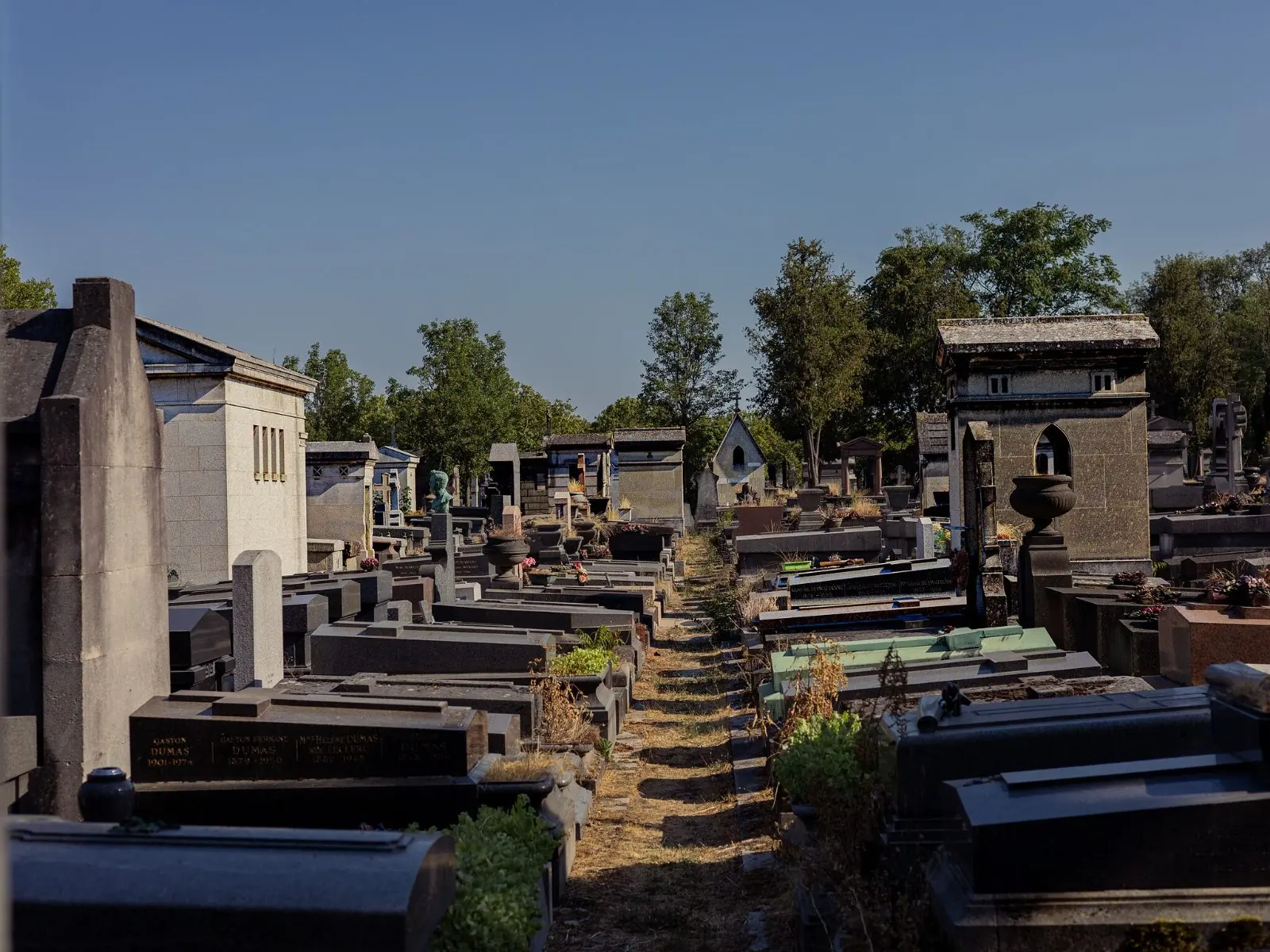
Père Lachaise is a working municipal cemetery in the 20th arrondissement of Paris, opened in 1804 and covering 44 hectares. It is the largest cemetery inside the city, the largest green space inside the city, and the most visited cemetery in the world, with around around 3 million visitors a year.
It is also, and this is the part people forget, still in use: around around 10,000 funeral ceremonies take place here annually. It is not a museum with graves in it. It is a burial ground that happens to hold the best open-air collection of nineteenth-century funerary sculpture in Europe.
Entry is free, every day, for everyone. There is no ticket, no ticket office and no booking system. We explain what those "Père Lachaise tickets" websites are actually selling, because the confusion is widespread and profitable.
If it is your first three days in Paris and you have a list, probably not — the Louvre and Sainte-Chapelle will do more for you. If you have five days or more, or any interest in nineteenth-century art, French history, literature or music, it is among the best two hours in the city and one of the very few that costs nothing.
What makes it worth the métro ride is not the famous names, although they are the reason most people come. It is the density. Two centuries of Parisian death, in every register from a bankrupt Irish playwright to a prefect who rebuilt the city, laid out on a hill in a garden, with the sculpture of each decade sitting next to the sculpture of the one before it. You can read the entire nineteenth century off these stones if somebody shows you how.
It is also, for most of the year and most of the day, quiet. Three million visitors sounds like a crowd, but they concentrate in about six places. Walk two divisions in any direction and you will be alone.
If you only have time for one Paris cemetery, this is the one — but the case is not open and shut, and we have compared it honestly with Montmartre and Montparnasse, both of which are also free and one of which is a great deal smaller.
The cemetery occupies a hill in the 20th arrondissement, bounded by boulevard de Ménilmontant, rue du Repos, rue des Rondeaux and rue de la Réunion. The administrative address is 16 rue du Repos, 75020 Paris; the main gate is on boulevard de Ménilmontant.
Four métro stations serve it. Philippe Auguste (line 2) is closest to the main gate. Père Lachaise (lines 2 and 3) is two minutes further and much busier. Gambetta (lines 3 and 3bis) is five minutes from the top gate. Alexandre Dumas (line 2) serves the eastern side.
Which one you choose matters more than it sounds, because the site climbs about thirty metres from the boulevard to the Gambetta gate. Enter at Gambetta and the whole visit is downhill; enter at the main gate and you will spend the first half of it climbing. Full directions, gate by gate, are here.
Buses 26, 60, 61, 64, 69, 71, 76 all stop within a few minutes of a gate.
From 16 March to 5 November the cemetery is open 08:00–18:00 Monday to Friday, 08:30–18:00 on Saturdays and 09:00–18:00 on Sundays and public holidays. From 6 November to 15 March, closing moves to 17:30; opening times are unchanged.
The detail that catches people out: clearing starts fifteen minutes before the posted closing time, and it works inward from the outlying gates. If you are up in the nineties at ten to six in July, you will be walked down. The hours page has all of this, plus the gate-by-gate detail.
The best hour of the day is the first one. Low light, no groups, and the upper divisions effectively empty.
The City of Paris describes the paths as old cobbles and packed earth — irregular, and in places very narrow. That is accurate and worth taking seriously.
The main avenues are surfaced and easy. Everything off them is nineteenth-century cobble lifted by two hundred years of tree roots, or bare earth that turns to mud. There are frequent short flights of steps between terraces, mostly without handrails.
Accessibility is partial. The main gate, the Porte du Repos and the Porte Gambetta are step-free; the Porte des Amandiers and the Porte de la Réunion are not. The avenues can be managed with a stick or a companion-pushed wheelchair; most individual graves cannot be reached that way. There is no seating on most routes, no shelter, and nowhere inside to buy food or water.
Wear shoes with a sole. Bring water. More detail on terrain and mobility.
Père Lachaise is divided into 97 numbered divisions, and the numbering is chronological rather than geographical: divisions 1–26 are the original 1804 cemetery at the bottom of the hill, and the eighties and nineties are the last eastern extensions up by Gambetta. The numbers ring outward from the old core.
This matters because the cemetery is signed by division, not by name. There are no signposts to individual graves. If you arrive knowing you want Chopin but not knowing he is in division 11, you will walk for forty minutes. If you arrive with the number, you will walk for five.
Write the numbers down before you come — mobile signal and GPS are both poor under the tree cover in the upper divisions. Our map page explains the layout, and the index of famous graves lists every division number. Free paper plans are available at the conservation office inside the Porte du Repos on weekdays.
Somewhere over a million people, in about seventy thousand plots, since 1804. The ones visitors come for are a vanishingly small fraction, and they cluster: Jim Morrison in division 6, Héloïse and Abélard in 7, Chopin in 11 and Molière and La Fontaine in 25 are all within fifteen minutes of the main gate.
The upper half holds Balzac in 48, Proust in 85, Oscar Wilde in 89, Victor Noir in 92, Gertrude Stein in 94 and Édith Piaf in 97. Delacroix is in 49, Seurat in 66, Modigliani in 96, Apollinaire in 86, Sarah Bernhardt, Allan Kardec, Simone Signoret and Yves Montand all in 44.
The most visited grave is Jim Morrison's, by a wide margin, and it is also the least interesting thing to look at. The best sculpture is almost never over a famous name.
The Mur des Fédérés (division 76) is the wall against which 147 Communards were shot on 28 May 1871 and buried in a trench where they fell. It has been a site of political pilgrimage ever since.
The Monument aux Morts (1899), by Albert Bartholomé, stands at the head of the main avenue: a relief of naked figures of every age walking into a doorway cut in the stone, with an ossuary behind it. There is no religious iconography in it at all.
The crematorium and columbarium (division 87) were designed by Jean-Camille Formigé after cremation was legalised in France in 1887; the first cremation took place in 1889. The building is Byzantine-revival, and deliberately so.
The deportation memorials (division 97) were placed from 1949 onwards by survivors' associations, commemorating individual concentration camps and the French Resistance. They are the most demanding sculptures here and among the least visited. More on all of this in the history.
The hill was a Jesuit retreat, named for Père François de La Chaise, Louis XIV's confessor. The city bought it in 1804 after Napoleon banned burial inside Paris, and Alexandre-Théodore Brongniart laid it out — not as a churchyard but as an English landscape garden with graves in it, which was a new idea in Europe and the model for every garden cemetery built since.
It failed. Too far out, too unfamiliar, and in its first year it took thirteen burials. The administration's fix, in 1817, was to transfer in the remains of Molière, La Fontaine, Héloïse and Abélard with maximum ceremony. Plot sales went from a trickle to a flood, and by 1830 there were more than 33,000 graves.
The rest is the nineteenth century happening on a hillside: five extensions, the fighting of May 1871, the crematorium, Bartholomé's monument, the memorials of the 1950s, and — from 1971 — the arrival of a wholly new kind of visitor. The full history is here.
One hour covers the lower divisions and four or five famous graves. Two to three hours gets you the shape of the whole place. Half a day lets you wander, which is the best way to see it.
Come early. The first hour after opening is quiet, well-lit and largely free of groups. Weekday mornings outside July and August are the ideal; Sunday afternoons in summer are the worst, and the cemetery opens an hour later on Sundays anyway.
Autumn is the best season here by some distance — the tree cover is extraordinary in late October, and the light is low all day. Winter is bleak, quiet and arguably the most appropriate. Rain improves it.
Funerals happen here every working day. If you walk into one, stop talking, step aside and wait, and do not photograph it. That is the only rule that really matters.
Otherwise: do not stand or sit on graves; do not leave objects on graves that are not yours; do not touch the monuments, because rubbed bronze loses its patina permanently and nineteenth-century limestone does not recover from being kissed. Picnics, bicycles, running, drones and dogs other than assistance dogs are all prohibited.
Both are legitimate and one of them is free. If you want to be alone with it, our written two-hour route gives you the divisions in order at no cost, and you should use it rather than paying anyone.
A guide is worth it when you want the connective tissue rather than a list of graves — why the monuments look the way they do, how the 1817 transfers made the place, what the symbolism on an anonymous tomb is claiming. Our small-group walk runs downhill from the Gambetta gate for two hours with a maximum of twenty people, and a private version can be built around one grave, one subject or one person's walking pace.
Whichever you choose, the cemetery itself remains free. Nothing on this page requires you to buy anything.
Start here
Take these numbers with you. The full index runs to nearly thirty, with a page of its own for the ten people ask about most.
1854–1900 · Writers
Jacob Epstein's winged monument, glazed since 2011 to stop the lipstick eating the stone.
Read the full entry →
1943–1971 · Musicians
A flat stone behind a low barrier, with a Greek inscription chosen by his father.
Read the full entry →
1915–1963 · Musicians
Buried under her married name, Lamboukas, with her father, her daughter and her second husband.
Read the full entry →
1810–1849 · Musicians
Clésinger's weeping muse over the grave. His heart is in Warsaw.
Read the full entry →
1871–1922 · Writers
A plain black marble family tomb, shared with the brother who got the book into print.
Read the full entry →
1874–1946 · 1877–1967 · Writers
One headstone, two names — Toklas's carved on the reverse, at her own request.
Read the full entry →
1799–1850 · Writers
A bust by David d'Angers, on the slope where he made Rastignac challenge Paris.
Read the full entry →
1848–1870 · Political figures
Dalou's recumbent bronze of a journalist shot by Napoleon III's cousin, and the funeral that nearly started a revolution.
Read the full entry →
The longer list is on our frequently asked questions page.
If you would rather not work it out on your own, our small-group walk covers the same ground in two hours with someone who can answer the questions the plaques do not.