Division 11 · Musicians · 1810–1849
Frédéric Chopin's grave at Père Lachaise
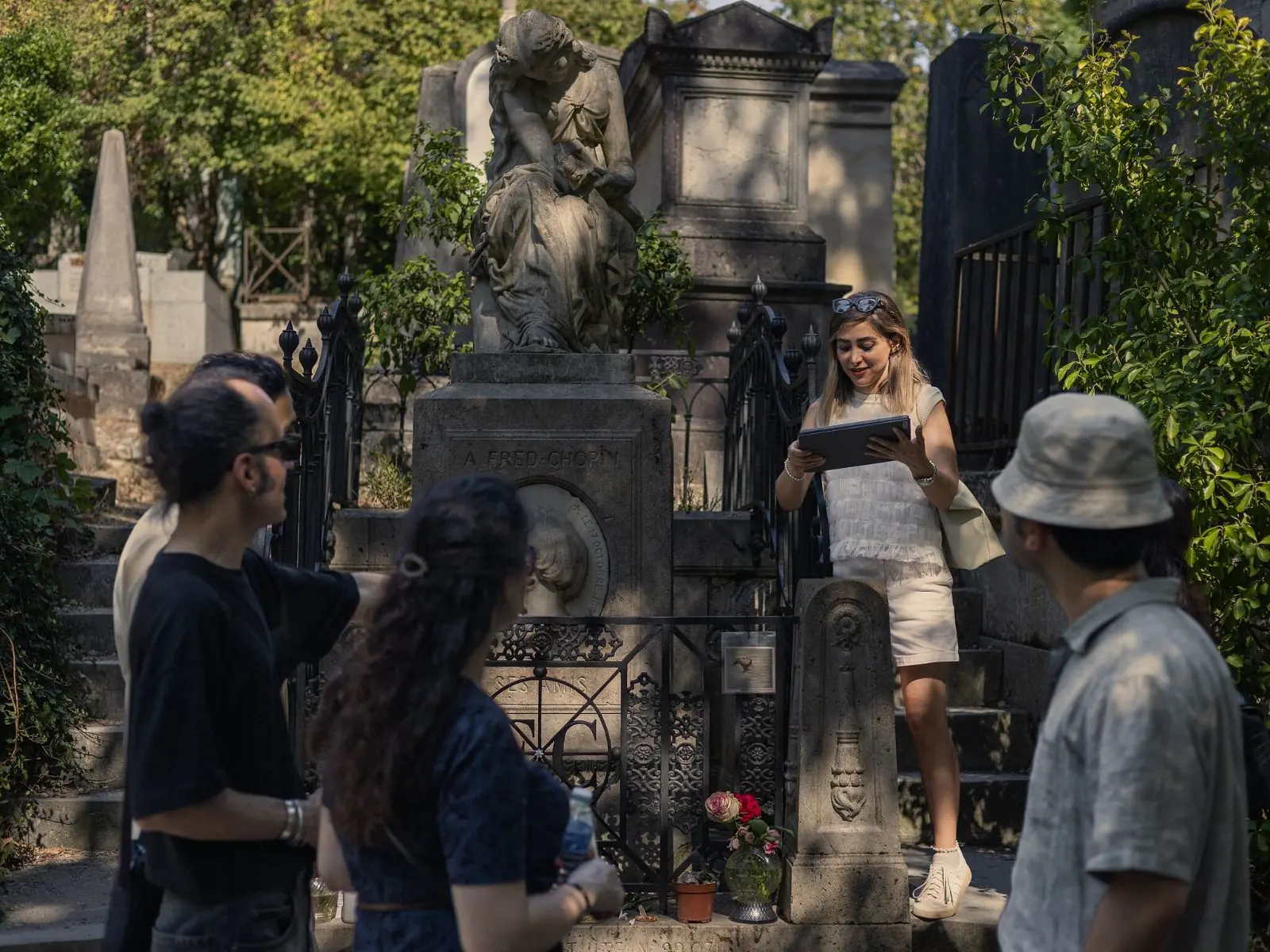
Frédéric Chopin is buried in division 11, about ten minutes' walk up from the main gate on boulevard de Ménilmontant. The monument is Auguste Clésinger's: Euterpe, the muse of music, seated and weeping over a broken lyre. The grave is almost never without flowers and Polish ribbons. His heart is not in it — it is sealed inside a pillar of a church in Warsaw, and has been since 1850.
A funeral delayed by a choir
Chopin died at 12 place Vendôme on 17 October 1849, at thirty-nine, after years of the illness that was called consumption and is now generally read as tuberculosis. His burial did not take place for thirteen days, and the reason is one of the better small stories in nineteenth-century Paris.
He had asked for Mozart's Requiem. The Requiem needs female voices, and the Madeleine did not permit women to sing in its choir. The negotiation took nearly two weeks. The church eventually agreed to let the women of the Paris Conservatoire sing from behind a black velvet curtain, and on 30 October some three thousand people were admitted by ticket. Chopin's own Funeral March was orchestrated for the occasion.
The monument
Auguste Clésinger — who had already taken Chopin's death mask and a cast of his left hand — carved the monument, and Jane Stirling, the Scottish pupil who had organised and largely financed Chopin's last years, paid for it. It was unveiled on the first anniversary of his death.
The seated figure is Euterpe, the muse of music, holding a lyre with a broken string. She is weeping, and Clésinger has given her the posture of exhaustion rather than grief — she has stopped playing and cannot start again. Above her, on the front of the plinth, is a medallion portrait of Chopin in profile.
At the burial, a silver urn of Polish earth was emptied over the coffin. Friends had given it to him when he left Warsaw in 1830, aged twenty, in the weeks before the November Uprising. He never went back.
Why his heart is in Warsaw
Chopin had a documented terror of being buried alive, and asked that his body be opened after death so that there could be no doubt. His heart was removed and preserved — in a spirit that later analysis suggests was cognac — and his sister Ludwika carried it out of France to Warsaw, reportedly beneath her cloak, past Russian customs.
It was sealed into a pillar of the Church of the Holy Cross on Krakowskie Przedmieście, where it still is. During the Second World War it was taken out for safekeeping and returned afterwards. In 2014 a small group of scientists was permitted to inspect the sealed jar without opening it; their published conclusion was that the visible signs were consistent with tuberculosis and its complications.
So the grave in division 11 is genuinely a partial grave, and knowing that changes how the monument reads. Euterpe is mourning a man who arranged, at the last, to be in two countries at once.
Finding it
From the main gate, take the avenue Principale, then bear left at the roundabout onto the chemin Denon. Division 11 is on the right as the ground begins to rise. If you cannot see the monument, follow the flowers: it is one of the few graves here that is reliably marked by fresh colour from thirty metres away.
Molière and La Fontaine are two minutes away in division 25, and Héloïse and Abélard in division 7 are downhill towards the gate. These four together make the best short introduction to the cemetery for anyone with only an hour — a route we set out in full in our free self-guided walk.
See division 11 on a guided walk
Our small-group walk runs downhill from the Gambetta gate for two hours, taking in about a dozen graves and the history that connects them. Entry to the cemetery is free either way.