Père Lachaise is free to enter, open every day of the year, and takes about two hours to see properly. If you read nothing else: get off the métro at Gambetta rather than Père Lachaise, and walk down.
That single decision is worth more than every other piece of advice on this page. The cemetery occupies a hill, the main gate on boulevard de Ménilmontant is at the bottom of it, and the Gambetta gate is about thirty metres higher. Almost everyone arrives at the bottom, climbs for an hour and a half in whatever the weather is doing, and arrives at Oscar Wilde exhausted. It is entirely avoidable.
What is different in 2026
Two things worth knowing before you plan around a specific gate.
The Porte de la Réunion, on the eastern side, can close temporarily for works. If you plan to enter from Alexandre Dumas for the Mur des Fédérés, check the City of Paris page before travelling; Gambetta is the reliable alternative.
The Porte des Amandiers continues to keep shorter hours than the rest of the cemetery — 10:00 to 17:00, pedestrians only — and it has steps. It is a useful shortcut if you are staying in Ménilmontant and a trap if you assumed it opened when the main gate did.
Everything else is as it has been. Entry is free, there is no ticket, and there is no booking system. If a website has sold you something called a Père Lachaise ticket, it has sold you a tour, an audio guide or a bundle — none of which you need to walk in.
Opening hours, and the fifteen minutes nobody mentions
From 16 March to 5 November: 08:00–18:00 Monday to Friday, 08:30–18:00 Saturday, 09:00–18:00 Sunday and public holidays.
From 6 November to 15 March: the same opening times, closing at 17:30.
The weekend openings are the ones that catch people out. Turning up at 08:15 on a Sunday in July, having got up early specifically to beat the crowds, means forty-five minutes on the pavement outside a locked gate.
The other detail is at the end of the day. The posted closing time is when the gates are locked, not when you need to be out. Clearing begins a quarter of an hour earlier and works inward from the outlying gates, which means the Gambetta gate — the useful one — closes first. If you are up in the nineties at ten to six in summer, you will be escorted down to the boulevard, and you will find yourself on a different métro line to the one you planned.
The best hour of the day
The first one. It is not close.
Père Lachaise opens at eight on a weekday, and for the first hour it is effectively empty above division 50. The light is low and raking, which is the light this place was designed for — Brongniart laid it out as a landscape garden, and the sculpture reads completely differently when it has shadows. Coach groups start arriving from about ten, and the lower divisions around Jim Morrison and Chopin can be genuinely crowded by eleven in July and August.
Second best is the last ninety minutes on a winter afternoon, when it gets dark early and there is almost nobody in it. You will be walking against the clock, but that is not the worst way to see a cemetery.
Worst is Sunday afternoon between May and September: latest opening, largest crowds, and the paths in the popular divisions become slow.
Getting there
Four stations, and the choice matters.
| Station | Lines | Puts you at | Walk |
|---|---|---|---|
| Gambetta | 3, 3bis | Porte Gambetta — the top of the hill | 5 min |
| Philippe Auguste | 2 | Main gate, quietest exit | 1 min |
| Père Lachaise | 2, 3 | Main gate, busiest exit | 2 min |
| Alexandre Dumas | 2 | Porte de la Réunion, eastern side | 7 min |
Buses 26, 60, 61, 64, 69, 71 and 76 all stop within a few minutes of a gate.
By taxi, give the street address of the gate you want — 55 rue des Rondeaux for Gambetta, 28 ter boulevard de Ménilmontant for the main gate. Saying “Père Lachaise” will get you to the main gate every time, which is a twenty-five-minute walk from the wrong end if you wanted the top.
What the ground is like
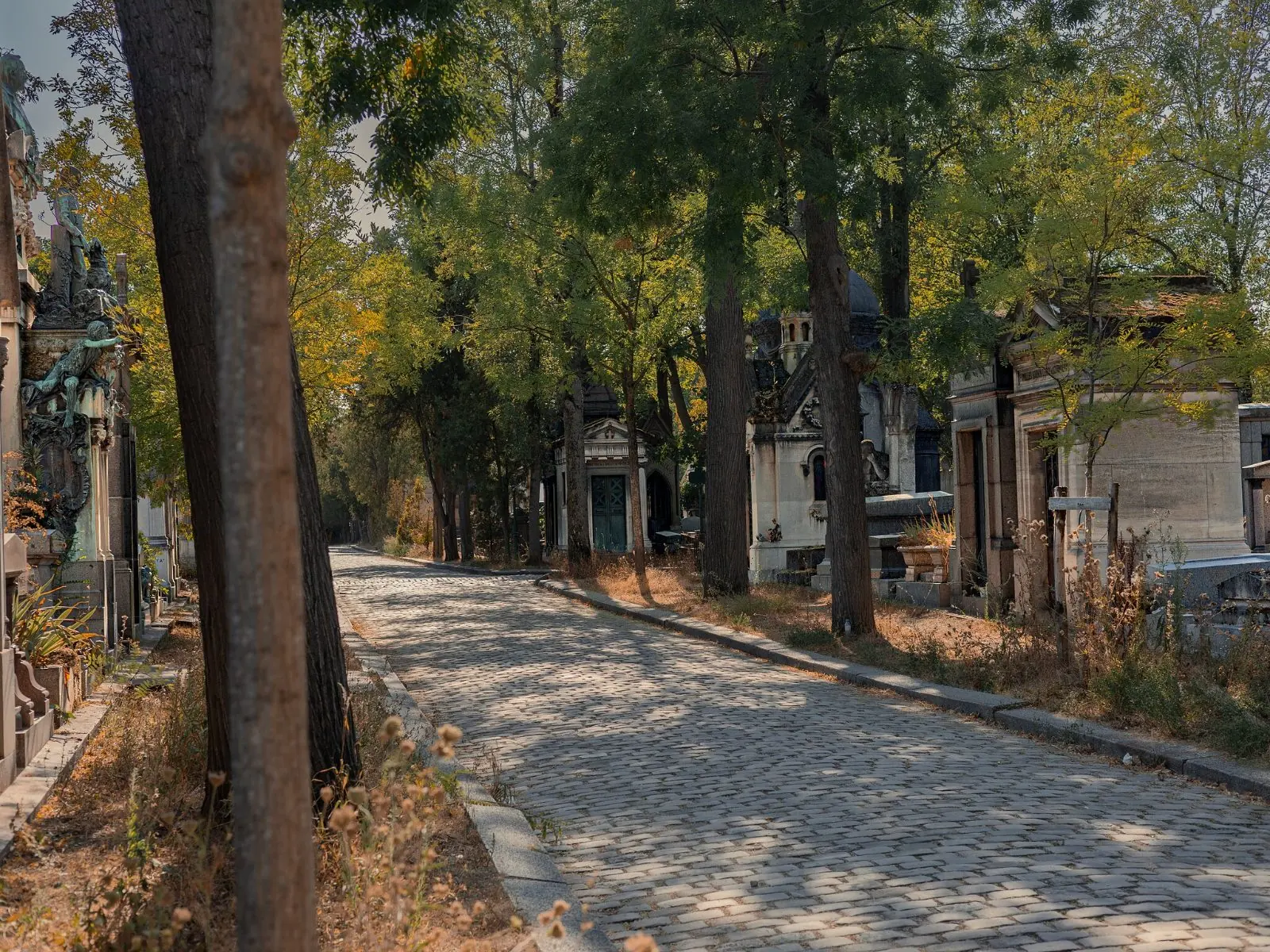
The City of Paris describes its own paths here as old cobbles and packed earth, irregular and in places very narrow. Take that literally.
The main avenues are surfaced and easy. Everything off them — which is to say, everything you actually came to see — is nineteenth-century cobble lifted by two hundred years of tree roots, or bare earth. There are frequent short flights of steps between the terraces and handrails on almost none of them.
Wear shoes with a sole. In wet weather the cobbles in the shaded upper divisions stay slippery long after the rain stops, and the earth paths turn to mud.
There is nowhere inside to buy food or water, no café, no shop, and public toilets only near the main entrance. Bring water. Eating is not permitted, so do not bring a picnic.
If you have limited mobility
Be honest with yourself about this, because the site will not make allowances.
Three of the five gates are step-free: the main gate, the Porte du Repos and the Porte Gambetta. The Porte des Amandiers and the Porte de la Réunion both have steps and are unusable if you cannot manage them.
The surfaced main avenues can be walked with a stick, and a companion-pushed wheelchair can use them. What they cannot do is reach most individual graves, which sit off the avenues. The gradients are real, and entering at Gambetta removes most of the difficulty at a stroke.
If you want to come but need the route planned around what you can do, a private walk can be routed along the avenues and we will send you the route in writing — naming what it reaches and what it misses — before you commit to anything.
Take the division numbers with you
The cemetery is signed by numbered division, and by nothing else. There are no signposts to individual graves.
This is the single most useful practical fact about visiting Père Lachaise. Arrive knowing you want Édith Piaf and you will walk for forty minutes. Arrive knowing she is in division 97 and you will walk for six.
Write the numbers down on paper before you come. The tree cover in the upper divisions degrades GPS badly and mobile signal at the Gambetta end is patchy, so a phone here will confidently show you standing forty metres from where you are — which, in a place navigated by division boundaries, is worse than no map at all. Our index lists the division for everyone, and free paper plans are available at the conservation office inside the Porte du Repos on weekdays.
A workable two hours
Come in at Gambetta and go: 97 (Piaf, and the deportation memorials nobody notices), 94 (Gertrude Stein), 89 (Oscar Wilde), 87 (the crematorium and columbarium), 92 (Victor Noir), 76 (the Mur des Fédérés), 85 (Proust), 48 (Balzac), the Monument aux Morts, 25 (Molière and La Fontaine), 11 (Chopin), 7 (Héloïse and Abélard), 6 (Jim Morrison), and out at the main gate.
That is a real route, it goes downhill the whole way, and it takes about two hours at a walking pace with stops. We have written it out properly, turn by turn, for anyone who would rather do it alone.
The one rule
Père Lachaise holds around ten thousand funeral ceremonies a year. On any given weekday morning, somebody is being buried here, and you may well walk into it.
If you do: stop talking, step off the path, wait, and do not photograph it. That is not a courtesy, it is the condition on which the whole place stays open to visitors at all.
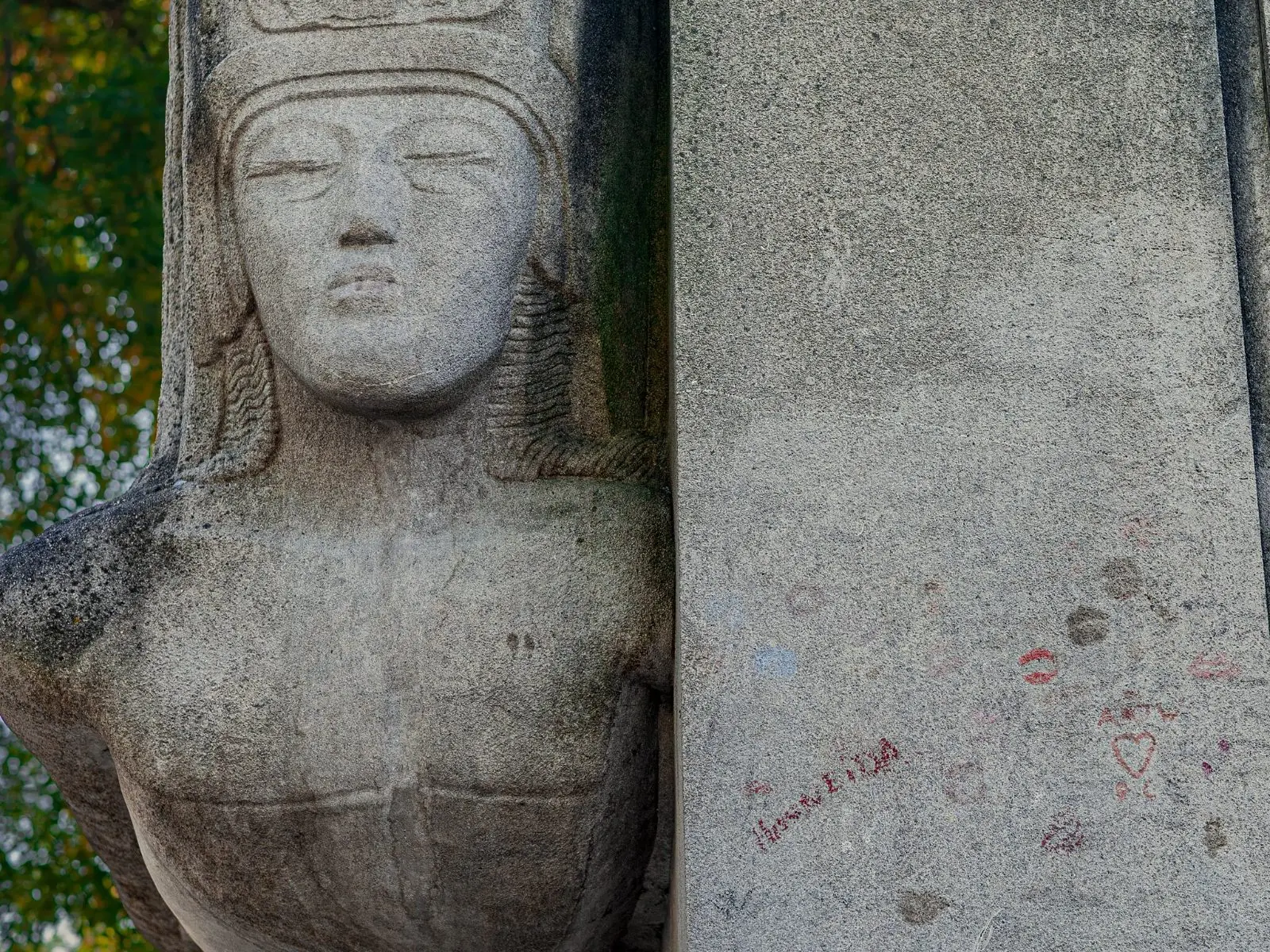
The rest follows from it. Do not stand or sit on graves, including the ones that look abandoned. Do not leave things on graves that are not yours. Do not touch the monuments — the lipstick on Oscar Wilde’s tomb ate through the stone until a glass wall had to be built around it, and rubbed bronze never recovers its patina.
Beyond that, walk wherever you like, stay as long as you like, and pay nothing. It is one of the very few things in central Paris of which all three are true.