Jim Morrison is buried in division 6 of Père Lachaise, about five minutes inside the main gate on boulevard de Ménilmontant. Entry to the cemetery is free and always has been.
The first thing everyone says on arriving is that it is smaller than they expected. It is a flat stone, set among older family tombs, with a bronze plaque on it and a low metal railing a couple of metres out. In summer there is often a guard nearby. There are almost always flowers, and usually a few objects that the staff will remove later.
That is it. There is no monument, no bust, no statue, nothing to climb on and nothing to sign.
How he came to be in Paris at all
Morrison arrived in March 1971, at twenty-seven, having largely stopped performing and having told several people he intended to stop being a rock singer altogether. He and Pamela Courson took an apartment at 17 rue Beautreillis in the Marais. He wrote, he drank heavily, and by most accounts he was trying to become a writer.
He died there on 3 July 1971. The French death certificate recorded heart failure and found no evidence of foul play; under French law, that closed the matter, and no autopsy was performed.
That single administrative fact is the origin of every conspiracy theory that has attached itself to him since. There is no forensic record, because the law did not require one, and into that gap fifty years of speculation has poured.
He was buried on 7 July, four days later, with something like half a dozen people present.
What is on the grave
For a long time, nothing. The plot was unmarked. A wooden marker appeared and disappeared.
In 1981 a Croatian sculptor, Mladen Mikulin, placed a stone bust of Morrison on the grave — without permission, as a gift. Visitors chipped pieces off it for a decade, and in 1988 it was stolen outright. It has never been recovered.
The plaque you see now was placed in 1990 by Morrison’s father, Rear Admiral George Stephen Morrison. It is flat, bronze, and gives his name and dates and a line of Greek:
ΚΑΤΑ ΤΟΝ ΔΑΙΜΟΝΑ ΕΑΥΤΟΥ
It is usually translated as true to his own spirit. The important word is daimon, which carries none of the modern English sense of a demon — in Greek it is the guiding spirit a person is born with, the thing that makes them what they are. His father chose it, which is worth pausing over given how their relationship is usually described.
Why the railing is there
Not because of Morrison. Because of what happened to his neighbours.
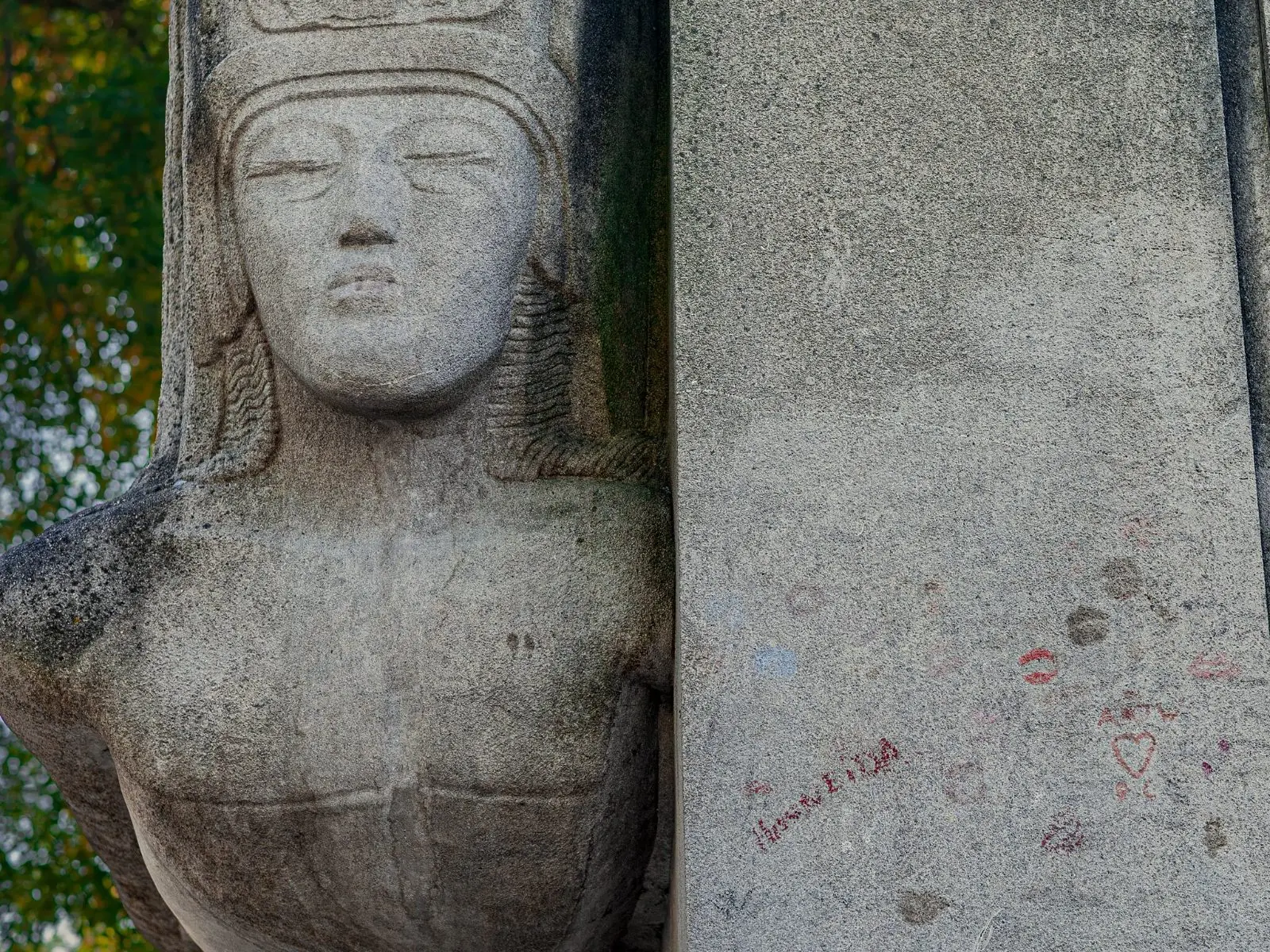
Through the 1980s and 1990s, visitors treated the surrounding family tombs as a noticeboard. Graves belonging to Parisian families who still visited them were covered in marker pen and spray paint. Objects were left everywhere. A tree beside the plot became so thickly caked in chewing gum that it required specialist cleaning.
The railing, the signage and the seasonal guard all date from that period. They are not a judgement on the man or on the people who come to see him; they are the ordinary management of a crowded corner with fragile things in it.
The practical consequence for a visitor is simple: stay outside the railing, and stay off the graves either side of it. Those belong to somebody.
Three myths worth retiring
The concession is expiring and he is about to be dug up
This one resurfaces every few years, usually with a date attached — 2021 was a popular one — and it is wrong.
French cemetery concessions come in fixed terms, typically ten, thirty or fifty years, and in perpetuity. Expired fixed-term concessions can be recovered by the commune and reused, which is why a great many nineteenth-century graves are no longer at Père Lachaise. The Morrison family hold a perpetual concession, the same category as Chopin’s or Oscar Wilde’s. There is no term to run out.
He is not really in there
The version usually told has Morrison faking his death and living out his life elsewhere. The evidence for it is the missing autopsy and the small, hurried funeral.
The evidence against it is dull and completely sufficient: a death certificate issued by a French municipal doctor, a burial permit, a coffin transported by a licensed undertaker to a registered plot, and a family who have had fifty-five years to request an exhumation and have never done so.
The cemetery wishes he were not here
The cemetery’s actual position is much less interesting than that. Division 6 receives a very large number of visitors in a small area surrounded by fragile nineteenth-century stone, and the administration manages it the way it manages any pressure point: barriers, signs, and someone standing nearby in August.
There is no plan to move him and no campaign to. He is simply the busiest square metre in a working cemetery.
What is actually interesting about it
Two things.
The first is the sheer disproportion. This is the most visited grave in the most visited cemetery in the world, and it is a plaque on the ground that you could walk past. Almost every other famous grave here was designed to be looked at — Epstein’s twenty tonnes for Wilde, Dalou’s bronze for Victor Noir, Clésinger’s weeping muse for Chopin. Morrison’s is the only one where the fame is entirely external to the object.
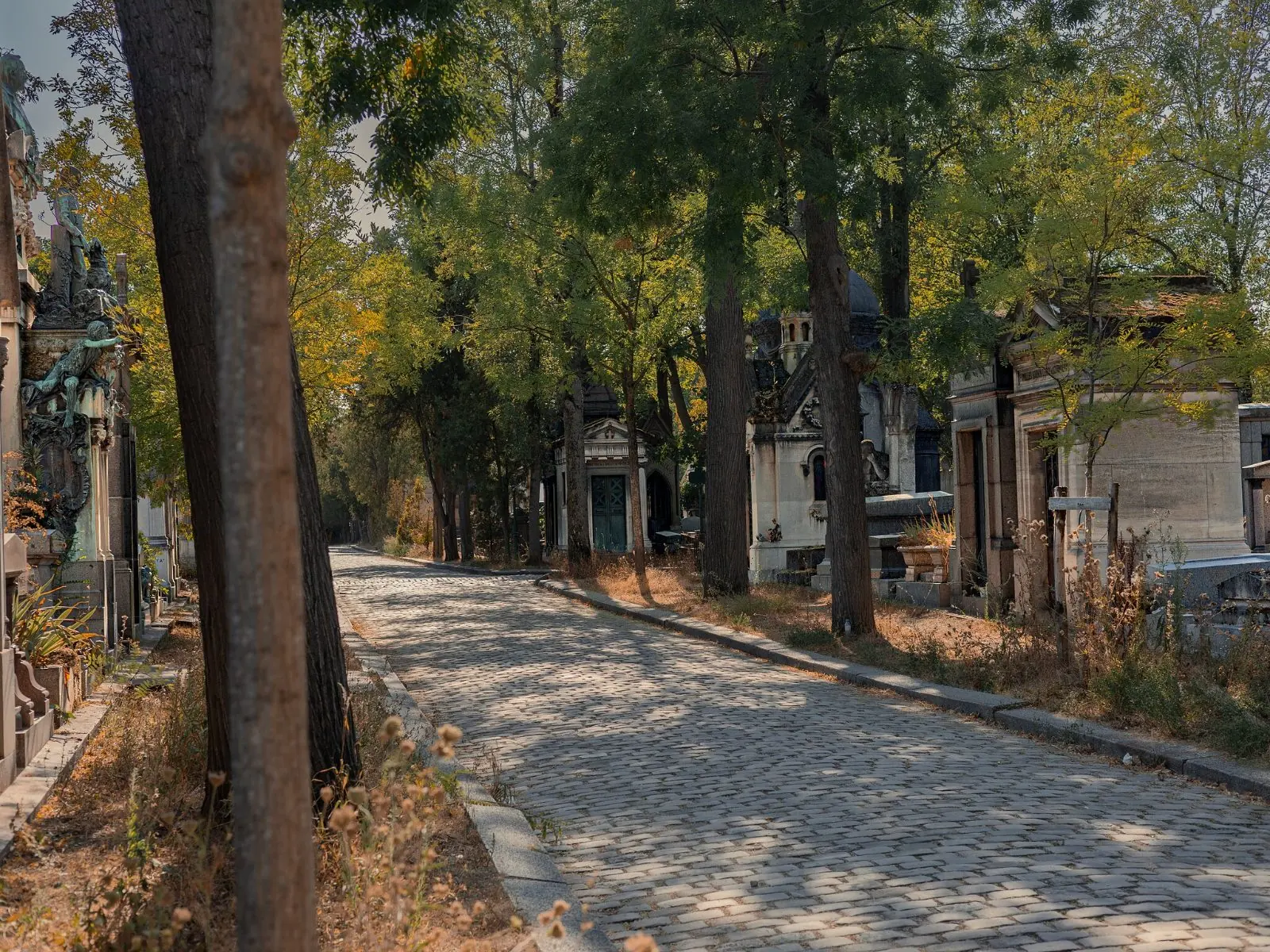
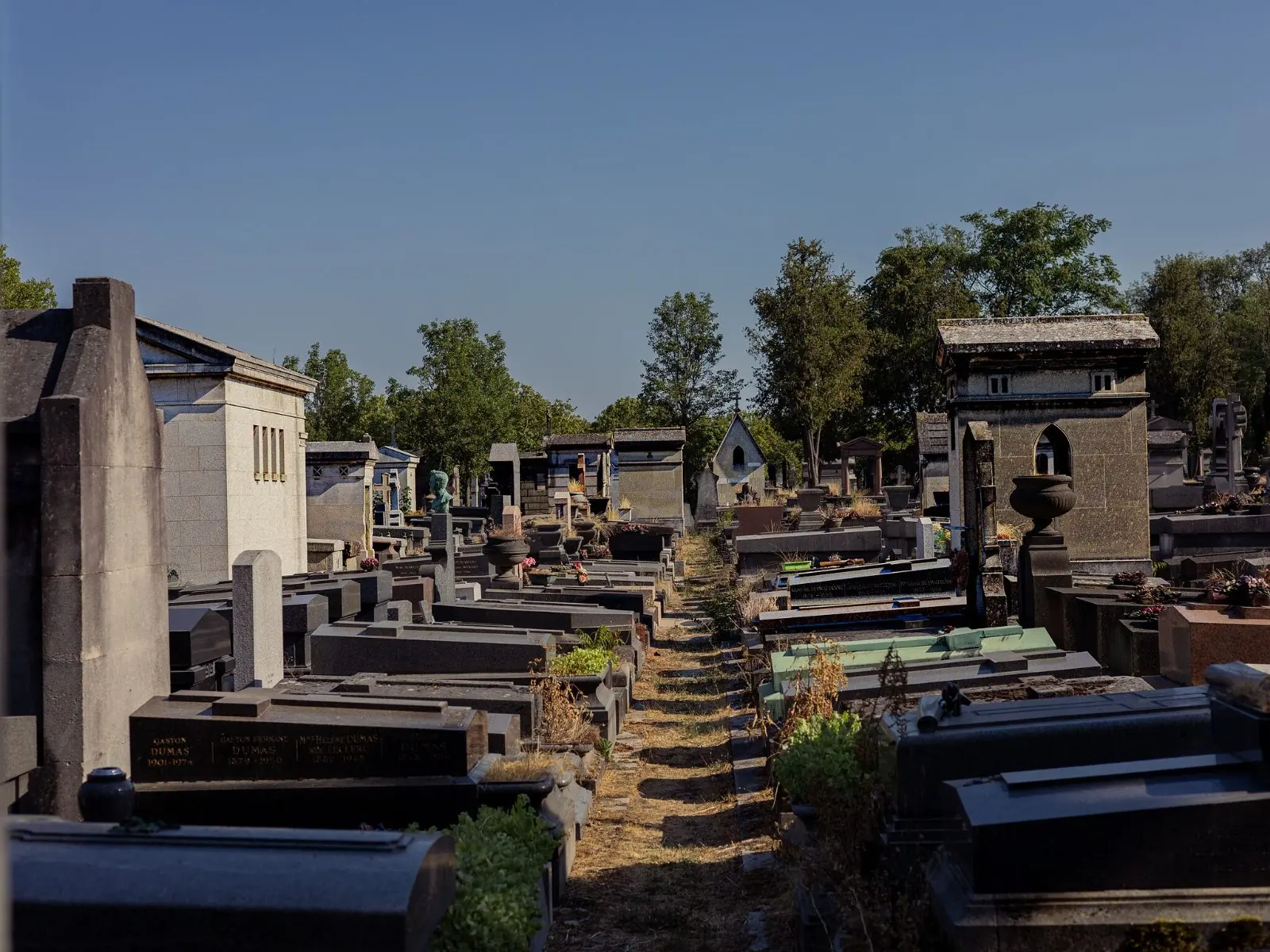
The second is the neighbours. Look past the railing at the tombs around it: 1860s and 1870s family vaults, a good deal of them lettered by hand, several with their doors rusted open. That is what division 6 is. Morrison is a late arrival in a block that had been full for a century, and the reason his plot exists at all is that a concession somewhere in it had come up.
Where the pilgrimage came from
Morrison was not, in 1971, an obvious candidate for a shrine. The Doors had been commercially successful and critically patchy, and he had spent his last two years mostly in legal trouble and out of the public eye.
The grave became a destination later, and in identifiable steps. The use of The End over the opening of Apocalypse Now in 1979 put him in front of a generation that had not been there. Danny Sugerman and Jerry Hopkins’s biography No One Here Gets Out Alive followed in 1980 and sold enormously. Oliver Stone’s film arrived in 1991, in time for the twentieth anniversary, and the crowds that year were large enough to require police.
Each of those waves left physical marks on division 6, and the cemetery’s response hardened with each one. The barrier you see is the accumulated residue of about fifteen years of that.
Getting there
From the main gate at 28 ter boulevard de Ménilmontant — métro Philippe Auguste (line 2) is the nearest station, or Père Lachaise (lines 2 and 3) — walk up the avenue Principale and take the first significant left. Division 6 is signed on a post at the corner of the block.
You will also see small hand-painted arrows on kerbstones pointing the way. The cemetery removes them and they come back within weeks.
While you are down here: Héloïse and Abélard are in division 7 just above, and Chopin is five minutes uphill in division 11. Both are worth more of your time than this stop, and neither of them will be busy.