Division 97 · Musicians · 1915–1963
Édith Piaf's grave at Père Lachaise
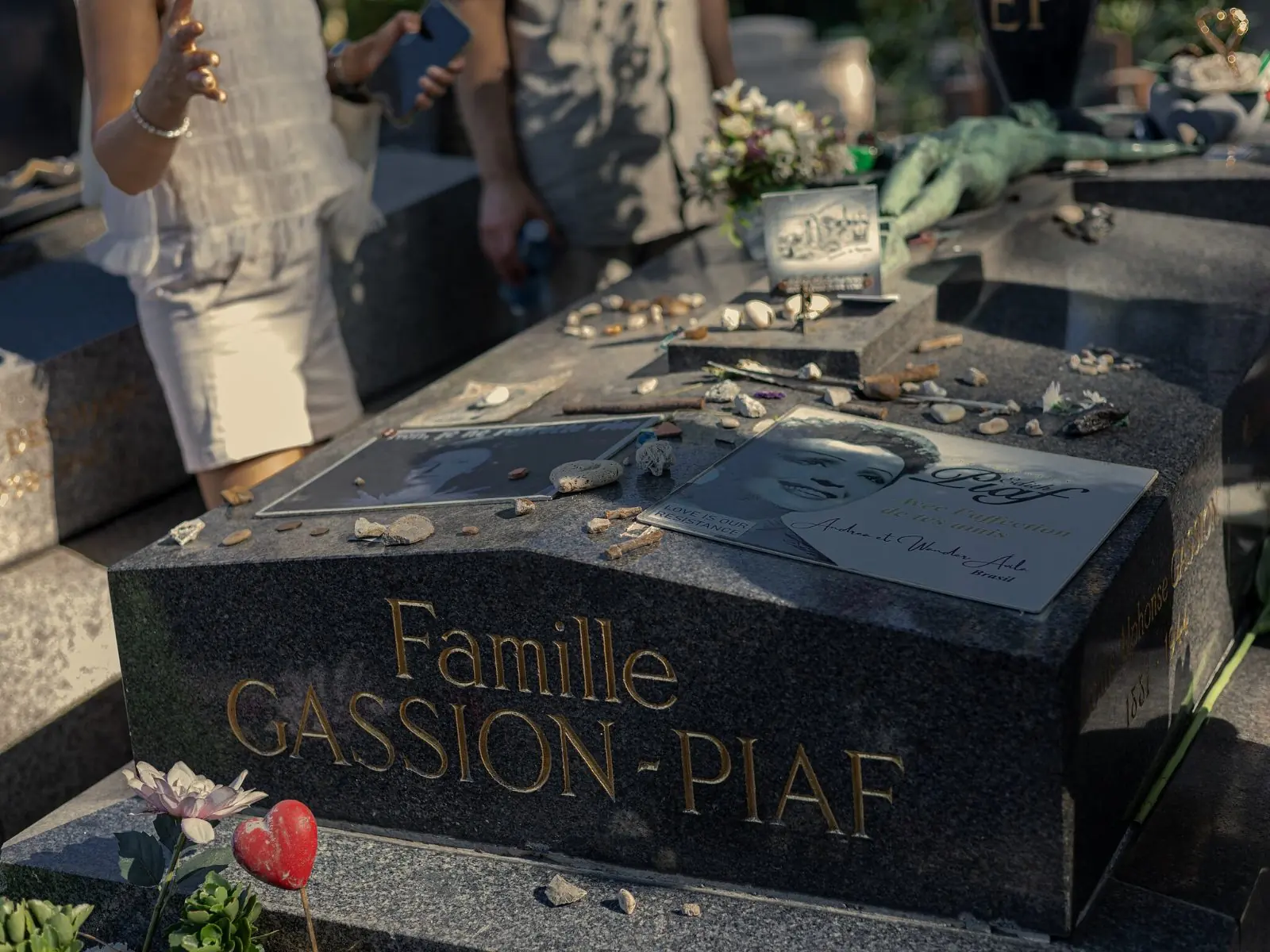
Édith Piaf is buried in division 97, in the north-eastern corner of the cemetery, about six minutes from the Gambetta gate. The grave is a flat black granite slab, usually banked with flowers, and it holds four people. Her name appears on it as Madame Lamboukas dite Édith Piaf — she is buried under her second husband's surname.
Belleville to Grasse
Édith Giovanna Gassion was born in December 1915 and grew up between a grandmother's brothel in Normandy and her father's street-acrobat pitches in Paris. Belleville, where the founding legend places her birth on the pavement of rue de Belleville, is a fifteen-minute walk from where she is now buried. She never moved very far.
She died on 10 October 1963 at Plascassier, near Grasse, at forty-seven, of liver failure after years of morphine and alcohol prescribed for the pain of a series of car crashes. Her body was driven overnight to her Paris apartment so that the death could be announced as having happened in the city. Jean Cocteau, her friend, died the same day on hearing the news.
The funeral, and the Mass that was refused
On 14 October 1963 something like forty thousand people came to Père Lachaise. Traffic in Paris stopped. It was, by most accounts, the only time since the end of the war that the city had halted completely for a private citizen.
The Archbishop of Paris refused her a funeral Mass, on the grounds that her life — the divorces, the public liaisons — disqualified her. A priest read prayers at the graveside instead. The Church revisited this half a century later: in October 2013, for the fiftieth anniversary, a memorial Mass was finally said for her at Saint-Jean-Baptiste de Belleville.
Who else is under the stone
The grave is a family plot, and the other three names on it carry most of the weight. Louis Alphonse Gassion, her father, the contortionist who took her out busking as a child, died in 1944. Marcelle Dupont, her daughter, born when Piaf was seventeen, died of meningitis in 1935 at the age of two. Théophanis Lamboukas, the Greek hairdresser twenty years her junior whom she married in 1962 and who performed as Théo Sarapo, was killed in a car crash in 1970 and buried with her.
The order of those dates is worth standing still for: the child died first, in 1935, and had to wait twenty-eight years for her mother.
What to look for
The slab itself is deliberately unremarkable — polished black granite, low to the ground, with a small crucifix. What changes is everything on top of it. Piaf's grave receives more left objects than any other in this part of the cemetery: flowers, obviously, but also handwritten notes, sheet music, coins and the occasional glass.
Look at the head of the stone for the phrasing of her name. Being buried as Madame Lamboukas — with dite Édith Piaf, "known as", appended — is the last small surprise she left. It reads, correctly, as a woman choosing to be a wife on her own gravestone.
Finding it, and the memorials beside it
Division 97 is close to the Gambetta gate, and the walk is nearly flat, which makes this one of the more manageable famous graves for anyone who does not want the hill. Follow rue des Rondeaux to the gate, go straight in, and bear left.
The same division holds the cemetery's memorials to the deportations — a group of sculptures raised from 1949 onwards by survivors' associations for the concentration camps and the French Resistance. They are the most powerful sculptures at Père Lachaise and almost nobody looking for Piaf notices them. Our page on the history of the cemetery explains how this corner came to be given over to them.
See division 97 on a guided walk
Our small-group walk runs downhill from the Gambetta gate for two hours, taking in about a dozen graves and the history that connects them. Entry to the cemetery is free either way.