Oscar Wilde died in a cheap hotel room on the rue des Beaux-Arts on 30 November 1900, aged forty-six, registered under the name Sebastian Melmoth. He was buried in a leased grave at Bagneux, outside the city — the kind of grave that gets emptied when the lease runs out.
The monument now standing over him in division 89 of Père Lachaise weighs twenty tonnes, was carved by a sculptor nobody had heard of, was paid for by a woman who insisted on anonymity, was covered by a tarpaulin and guarded by a policeman for the better part of a year, and has been enclosed in glass since 2011. Almost nothing about it is straightforward.
Nine years at Bagneux
The man who moved him was Robert Ross. Wilde’s literary executor and, from the early 1890s, one of the few friends who neither abandoned him nor exploited him, Ross spent the decade after Wilde’s death doing something quietly extraordinary: paying off the bankruptcy.
Wilde had been declared bankrupt in 1895, and the estate was still in the hands of the Official Receiver. Ross gathered the copyrights, negotiated with the creditors, and by 1906 had cleared the debts out of royalties. Only then was there any money, and any standing, to do anything about the grave.
He bought a perpetual concession at Père Lachaise, and in July 1909 Wilde was transferred from Bagneux to division 89.
Two thousand pounds, anonymously
The monument was funded by Helen Carew, who gave £2,000 on the condition that her name be kept out of it. The sum is difficult to render in modern money and easy to characterise: it was more than most people earned in a decade, given for a memorial to a man whose name was still, in 1908, considered unsayable in polite English drawing rooms. Her identity became public later; there was also a contribution from the novelist Stephen Hudson.
Ross’s choice of sculptor was the surprising part. Jacob Epstein was twenty-eight, American-born, recently arrived in London, and known mainly for a set of figures on the British Medical Association building in the Strand that had already caused a public row about nudity. Ross gave him the commission and, as far as the record shows, no instructions at all.
Epstein spent close to three years on it. He worked directly into a single block of Hopton Wood stone — a hard, pale, close-grained limestone from Derbyshire — of around twenty tonnes.
What he actually carved
Not an angel, whatever the guidebooks say.
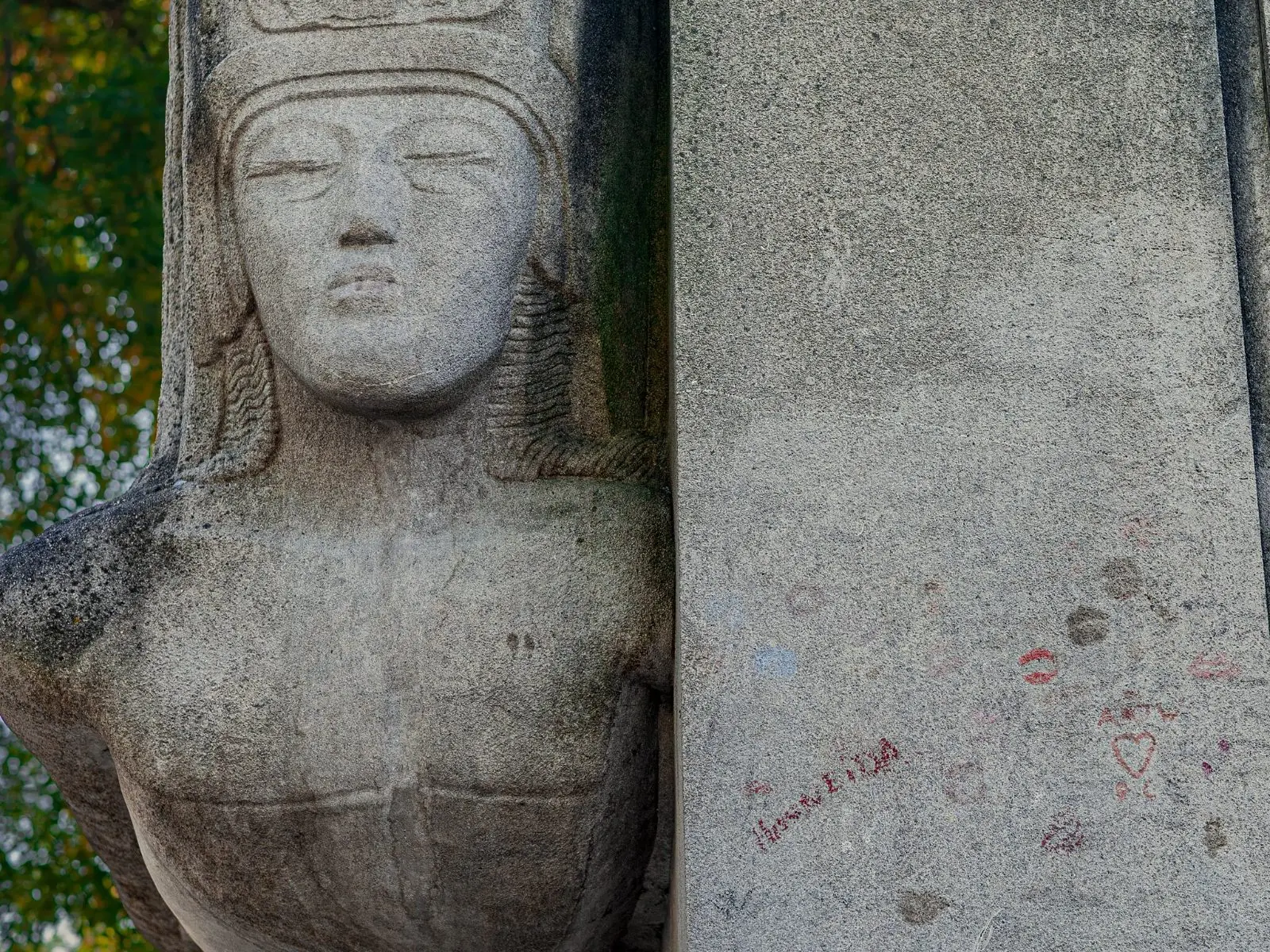
The figure is a winged male in horizontal flight, its face broad and flattened, its hair rendered as a series of parallel incised bands, a diadem across its brow. It does not ascend; it moves forward, across the front of the block, the way a relief on a palace wall moves.
Epstein had been spending a great deal of time in front of the Assyrian winged bulls in the British Museum, and it is written all over the carving: the frontal stylisation, the treatment of the feathers as pattern rather than plumage, the sense of a guardian rather than a mourner. This is a demon-messenger out of the ancient Near East placed over a Christian burial in a Paris cemetery, and in 1912 that was a genuinely radical thing to put on a tomb.
It is also, structurally, a piece of modernism arriving three years before anyone in Britain had a word for it. Epstein went on to Rock Drill; the Wilde tomb is the hinge.
The tarpaulin
The French authorities were not pleased, and their objection was specific: the figure had genitals, carved with the same flat stylisation as everything else, and they were considered indecent.
When the monument arrived at Père Lachaise in 1912, the cemetery covered it with a tarpaulin and posted a gendarme to stop anyone lifting it. Epstein refused to modify the carving. A period of negotiation followed that involved, at various points, the British ambassador, a plaster fig leaf, and a good deal of press coverage in two countries. It was finally unveiled in 1914.
The genitals did not survive the century. At some point they were struck off — the usual account has it happening in the 1960s — and the covers improvised at various times have long since disappeared. What remains is a smooth, damaged area that most visitors do not notice at all.
What is written on it
On the back of the block, cut in capitals, is a stanza from The Ballad of Reading Gaol, the only thing Wilde wrote after prison:
And alien tears will fill for him Pity’s long-broken urn, For his mourners will be outcast men, And outcasts always mourn.
Ross chose it. There is also a small niche cut into the plinth, and Ross asked to be put in it. In 1950, on the fiftieth anniversary of Wilde’s death, his ashes were placed there, forty-two years after he had started clearing the debts.
The kisses
Some time in the 1990s people began kissing the tomb in lipstick. Nobody knows who started it. By the mid-2000s the lower two-thirds of the monument was solid red, layered, and photographed constantly.
It looked like affection and it was affection. It was also destroying the monument.
Hopton Wood is a limestone, and limestone is porous. The pigment in lipstick sits on the surface; the grease carries it into the stone. Once it is in, water will not shift it — removing it needs solvents, and solvents attack the calcium carbonate binding the stone together. Every clean took a thin layer of Epstein’s carving with it, and by 2010 the tomb had been cleaned repeatedly. Conservators looking at it were describing irreversible loss of surface detail.
The glass
In 2011, on the 111th anniversary of Wilde’s death, the monument was restored under the direction of Merlin Holland, Wilde’s grandson, with funding from the Irish state and the cooperation of the Ville de Paris. The stone was cleaned properly for the last time, consolidated, and enclosed in a glass barrier standing a little way out from the block.
There was some grumbling at the time about sanitising a piece of living tradition. Fifteen years on, the compromise looks close to perfect. The kissing simply moved to the glass, which is wiped clean regularly and costs the monument nothing. The tradition survives. The carving survives. Nobody was told to stop loving anything.
It is worth saying, standing there, that this is unusual. Most conservation decisions of this kind involve telling the public that their behaviour is the problem. This one found a way to let a hundred thousand people go on doing something slightly ridiculous and entirely sincere, on a sheet of glass, in front of a monument that will now outlast all of them.
Seeing it
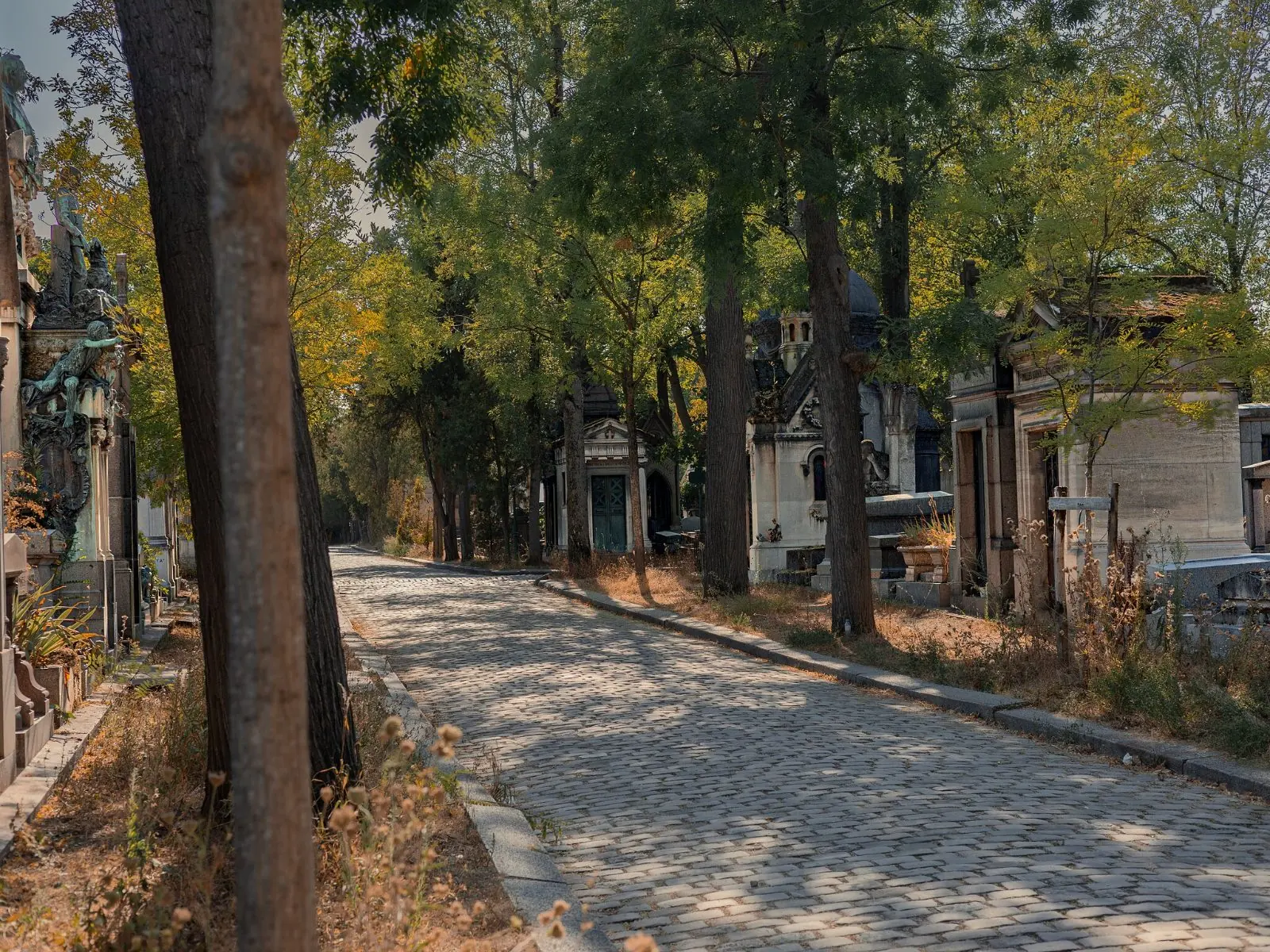
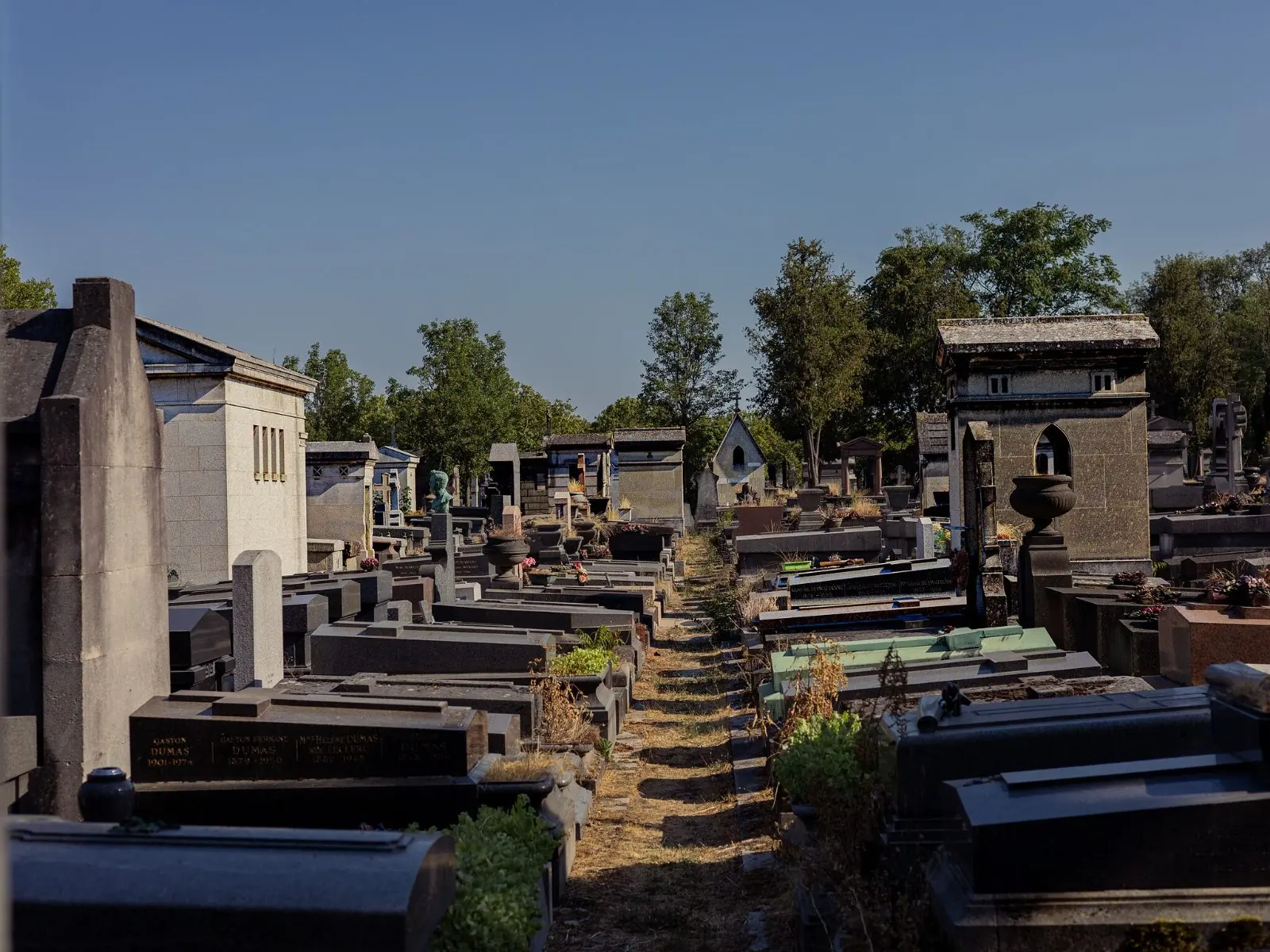
Division 89 is in the upper eastern quarter, about eight minutes from the Porte Gambetta at 55–57 rue des Rondeaux. Come in that way rather than from the boulevard: the alternative is twenty-five minutes of climbing.
Look at the face first, and then walk round to the back for the inscription and the niche. Then look at how the block sits — Epstein left the lower portion barely worked, so the figure appears to be emerging from a rough mass, which is the oldest trick in carving and one of the best. Then look at the glass, and at what is on it.
Gertrude Stein is five divisions away in 94, and the crematorium is just below in 87. The rest of the upper divisions are set out here.