Division 89 · Writers · 1854–1900
Oscar Wilde's grave at Père Lachaise
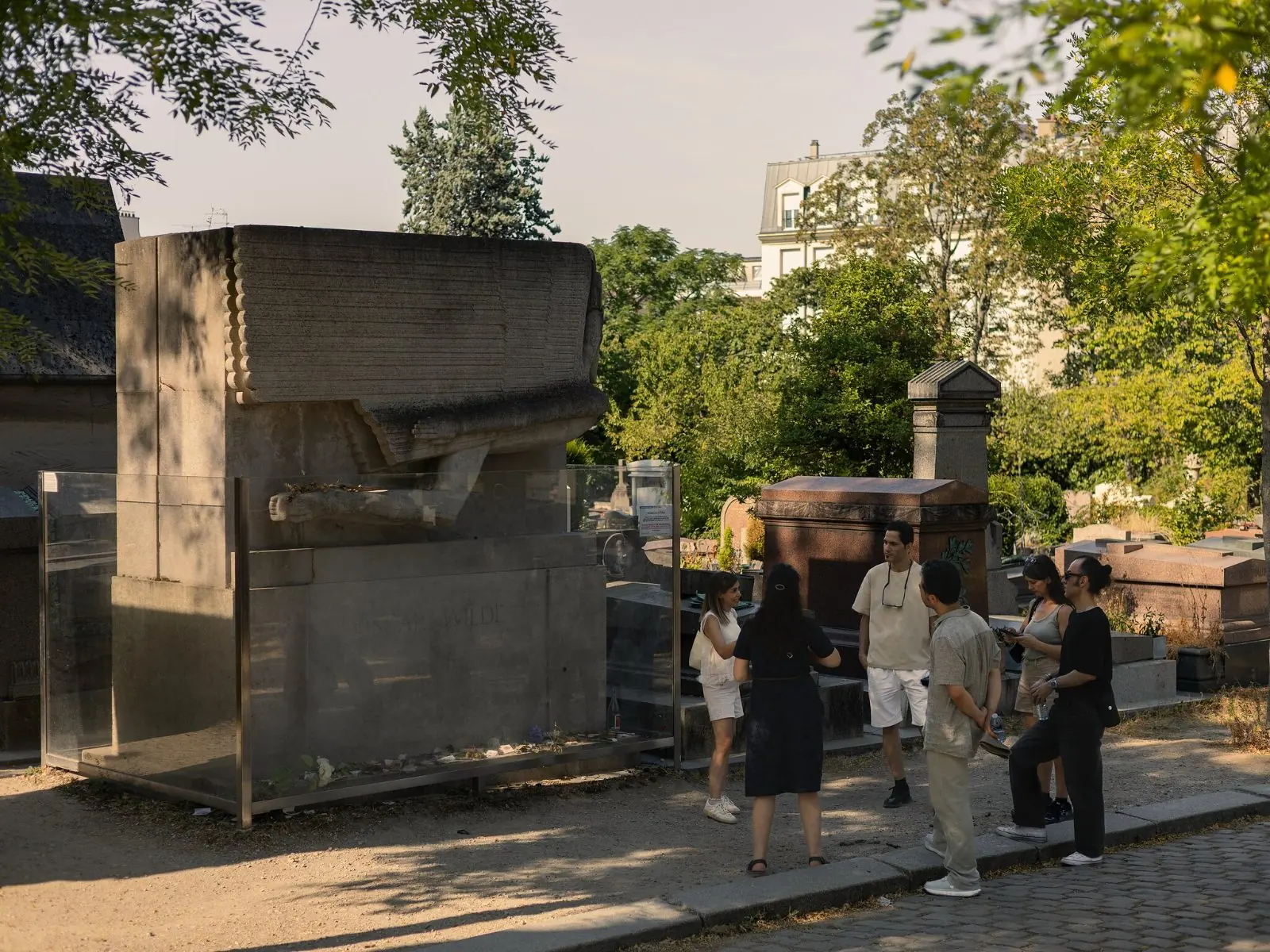
Oscar Wilde is buried in division 89, in the upper eastern quarter of Père Lachaise, about eight minutes' walk from the Gambetta gate. The monument is Jacob Epstein's, carved between 1909 and 1912 from a single twenty-tonne block of Hopton Wood stone, and it has been enclosed in glass since 2011. He was not buried here originally: he arrived nine years after his death, from a rented grave in the suburbs.
Who he was, by the end
The Wilde who died in Paris on 30 November 1900 was not the Wilde of the photographs. He was forty-six, penniless, living in a cheap room at the Hôtel d'Alsace on rue des Beaux-Arts under the name Sebastian Melmoth, and dying of meningitis that had followed an ear infection — an infection widely thought to trace back to an injury from his two years of hard labour in Reading Gaol.
He had been out of prison for three and a half years. In that time he had written one thing, The Ballad of Reading Gaol, published under his prison number rather than his name. His funeral was a small one at Saint-Germain-des-Prés, and he was buried in a leased grave at Bagneux, outside the city, of the sort that gets emptied when the lease runs out.
How he ended up at Père Lachaise
The man who moved him was Robert Ross, Wilde's literary executor and the friend who had stayed. Ross spent a decade paying off Wilde's bankruptcy from the royalties, and once the estate was solvent he bought a perpetual concession at Père Lachaise and had the body transferred in July 1909.
The monument was paid for by Helen Carew, who gave £2,000 anonymously — an enormous sum — and asked that her name be kept out of it. Ross commissioned Jacob Epstein, then twenty-eight and almost unknown, and gave him a free hand. Epstein spent nearly three years on it.
What you are looking at
Epstein carved a winged male figure in flight, its face flattened and hieratic, more Assyrian than angelic. He had been looking hard at the winged bulls in the British Museum, and it shows: this is a messenger out of the ancient Near East, not a Christian angel, and it is moving horizontally rather than ascending.
The cemetery authorities were not pleased. The figure's genitals were considered indecent, the tomb was covered with a tarpaulin, and a policeman was posted to stop anyone lifting it. It was finally unveiled in 1914. The genitals did not survive the century — at some point they were struck off, and Epstein's own attempt at a modest bronze cover is long gone.
On the back, cut into the stone, is the stanza from The Ballad of Reading Gaol that Ross chose: "And alien tears will fill for him / Pity's long-broken urn, / For his mourners will be outcast men, / And outcasts always mourn." There is also a small niche in the plinth. Ross asked to be put in it, and in 1950 his ashes were.
The kisses, and why they had to stop
Some time in the 1990s people began kissing the tomb in lipstick. By the 2000s the lower half of it was solid red. It looked like affection, and it was — but Hopton Wood is a porous limestone, and the grease in lipstick soaks into it. Removing the marks needed solvents, and every solvent clean took a thin layer of stone with it.
In 2011, on the 111th anniversary of Wilde's death, the tomb was restored under the direction of his grandson Merlin Holland, with funding from the Irish state, and a glass barrier was raised around it. The kissing has simply moved to the glass, which is cleaned regularly and costs the monument nothing. This is a rare case of a heritage compromise that gave everyone what they wanted.
Finding it, and what else is nearby
Come in at the Porte Gambetta rather than the main gate — Wilde is near the top of the hill, and arriving from below means twenty-five minutes of climbing first. From the gate, follow the avenue Pacthod and bear right; division 89 is signed, and the monument is tall enough to spot over the surrounding tombs.
Gertrude Stein is a few divisions away in 94, and the crematorium and columbarium sit just below in division 87. If you are working out an order to walk them in, our division-by-division map page explains how the numbering works, which is less obvious on the ground than it sounds.
See division 89 on a guided walk
Our small-group walk runs downhill from the Gambetta gate for two hours, taking in about a dozen graves and the history that connects them. Entry to the cemetery is free either way.