Paris has three great nineteenth-century cemeteries, and they were built for the same reason within twenty years of each other. When Napoleon banned burial inside the city in 1804, the plan was one cemetery for each direction: Père Lachaise in the east (1804), Montparnasse in the south (1824) and Montmartre in the north (1825).
All three are free. All three are open every day. And they are much less alike than that origin suggests.
The short answer
Père Lachaise if you are choosing one and you want the full thing: the most famous graves, the best sculpture, the most history, and a hill.
Montparnasse if you want twentieth-century writers and artists, a flat walk, and half the crowds.
Montmartre if you want atmosphere over names, an hour rather than three, and the single strangest setting of the three.
Size and shape
| Père Lachaise | Montparnasse | Montmartre | |
|---|---|---|---|
| Opened | 1804 | 1824 | 1825 |
| Size | 44 hectares | 19 hectares | about 11 hectares |
| Ground | Steep hill, 30 m of climb | Flat | Sunken former quarry |
| Layout | Winding, landscape garden | Regular grid | Irregular, terraced |
| Time to see | 2–3 hours | 1–2 hours | 1 hour |
| Nearest métro | Gambetta, Philippe Auguste | Edgar Quinet, Raspail | Blanche, Place de Clichy |
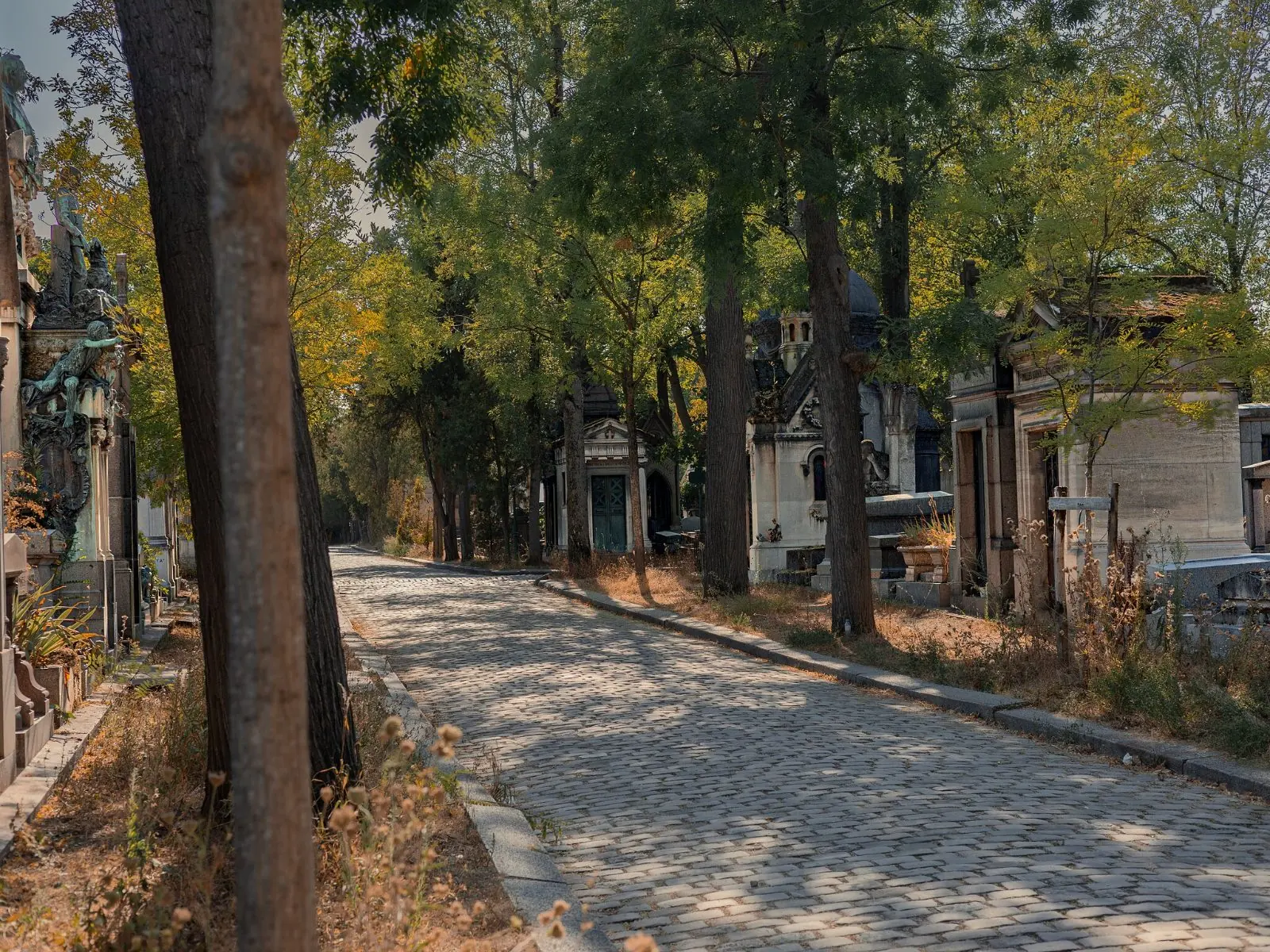
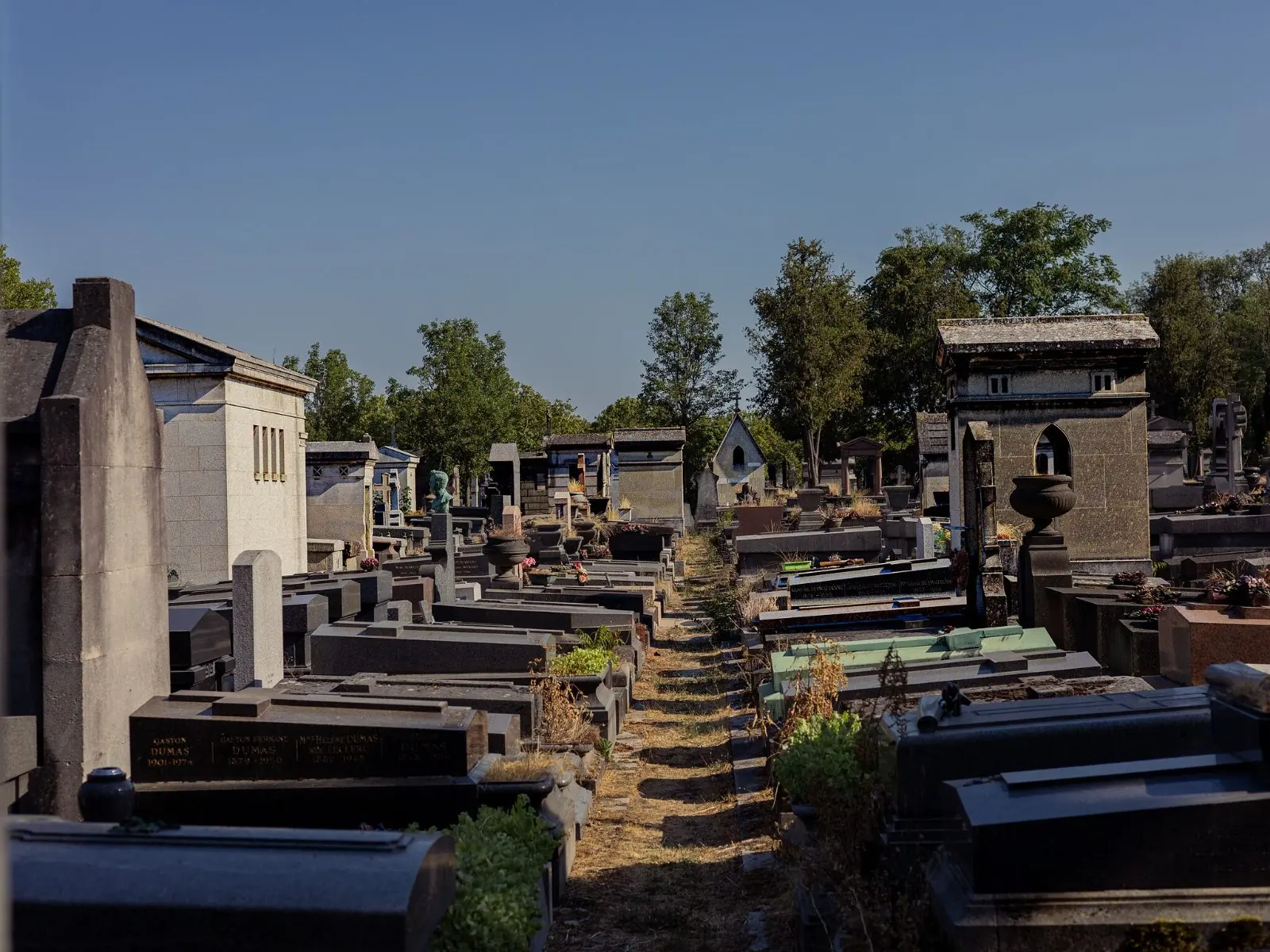
The shape differences matter more than the size ones. Père Lachaise was laid out by Brongniart as an English landscape garden with curving paths and modelled ground, which is why it feels like somewhere to wander and why it is exhausting. Montparnasse is a grid, which makes it far easier to navigate and considerably less atmospheric. Montmartre sits in a former gypsum quarry below street level, which is why you enter it by walking down, and why the rue Caulaincourt road bridge runs directly over part of it.
Who is where
Père Lachaise holds Oscar Wilde, Jim Morrison, Édith Piaf, Chopin, Proust, Molière, La Fontaine, Balzac, Delacroix, Gertrude Stein, Sarah Bernhardt, Apollinaire, Modigliani, Seurat and Méliès, plus the Mur des Fédérés and Bartholomé’s Monument aux Morts. It is not close.
Montparnasse is the twentieth century’s cemetery. Sartre and Simone de Beauvoir share a grave near the entrance. Samuel Beckett is under a plain grey slab. Baudelaire is here twice — in his stepfather’s family grave, which he would have hated, and again in a cenotaph. Also: Maupassant, Serge Gainsbourg, Man Ray, Brâncuși, Susan Sontag, Cioran, Ionesco, Cortázar, Saint-Saëns, Dreyfus, Jean Seberg and Marguerite Duras. Brâncuși’s The Kiss, carved in 1909 for the grave of a young Russian woman, is here and is worth the trip on its own.
Montmartre has Degas, Berlioz, Stendhal, Offenbach, Alexandre Dumas fils, Nijinsky, Gustave Moreau, Adolphe Sax, François Truffaut and Dalida — whose grave, with its full-length statue, receives more visitors than anything else there. Zola has a tomb here, but he is not in it: he was moved to the Panthéon in 1908.
Which is actually better to walk in
This is the question people mean and rarely ask.
Père Lachaise wins on density and on drama. The combination of the gradient, the two-hundred-year-old tree cover and the sheer accumulation of monuments produces something no other cemetery in the city has. It is also the only one where you can genuinely get lost, which is either the point or the problem depending on your temperament.
Montmartre is the most atmospheric per minute. Being below street level, with a road bridge overhead and the cliff of the quarry on one side, gives it a compression the others do not have. It is small enough to walk in an hour without a plan, and quiet almost always.
Montparnasse is the most comfortable and the least evocative. Flat, gridded, open, well-signed — you will not get lost and you will not be moved. What it has instead is the best twentieth-century company in Paris, and if you have come for Beckett or Gainsbourg or Brâncuși then none of the above matters.
What each one tells you about its century
The three cemeteries were founded within twenty-one years of each other and they are not, in the end, three versions of the same thing. They are three answers to a question that was still open.
Père Lachaise was the argument that a cemetery should be a garden. Brongniart’s plan is a piece of Enlightenment landscape thinking — that the dead belong in nature rather than in a churchyard, that mourning is improved by a view, that a burial ground can be somewhere you go voluntarily. It was a radical proposition in 1804 and it was so completely vindicated that every cemetery in the following century copied it, from Highgate to Mount Auburn to Recoleta.
Montparnasse, twenty years later, is what the idea looks like once it has become policy. The grid, the regular blocks, the straight avenues: this is a municipality building a cemetery because it has to, efficiently, on flat ground it already owned. There is nothing visionary in the plan and nothing wrong with it either.
Montmartre is what happens when you have run out of flat ground. It is in a quarry because the quarry was there, it is below street level because that is where the floor was, and in 1888 the city ran a road bridge across the top of it because the traffic had to go somewhere. It is the least designed of the three and, for exactly that reason, the one with the most character.
Walking all three in the right order — Père Lachaise, then Montparnasse, then Montmartre — is a short course in how an idea becomes a system and then becomes whatever fits.
Practicalities, all three
Entry is free at all of them. None of them sells tickets, and none of them can be booked. The City of Paris runs all of its intramural cemeteries to the same seasonal pattern — 08:00 on weekdays, 08:30 Saturdays, 09:00 Sundays and holidays, closing at 18:00 in summer and 17:30 in winter, with clearing beginning fifteen minutes earlier — but individual sites vary their gate hours, so check the City’s page for whichever one you are heading to.
All three are signed by division number rather than by name, so look up the numbers before you go for any of them. All three have free plans available at their conservation offices. And all three are working cemeteries with funerals in them, which means the same rule applies in each: if you walk into one, stop, step aside and wait.
If you have time for two
Do Père Lachaise properly and Montmartre briefly. They are the two most different from each other, they are on opposite sides of the city, and an hour in Montmartre after a morning in Père Lachaise reads as a genuine contrast rather than as more of the same.
Doing Père Lachaise and Montparnasse on the same day is the combination people most often attempt and the one most likely to blur. Both are large, both are literary, and by the second one you will have stopped looking.
And a fourth, if you want it empty
Passy, above the Trocadéro in the 16th, is a small, very grand cemetery of about two hectares with Debussy, Manet, Berthe Morisot and Fauré in it. It is heated — genuinely, it was built with a heated waiting room — and it is nearly always deserted. Twenty minutes, and almost nobody who visits Paris has heard of it.
If you do choose Père Lachaise, our visitor guide covers the practicalities and our free two-hour route gives you a way through it that never once walks uphill.