Père Lachaise opens at 08:00 Monday to Friday, 08:30 on Saturdays and 09:00 on Sundays and public holidays. It closes at 18:00 from 16 March to 5 November, and at 17:30 from 6 November to 15 March.
Entry is free, every day, and there is nothing to book. Those two sentences cover most of what people need. The rest of this is about the difference between the hours the gate is open and the hours worth being there.
The seasonal switch
There are only two seasons in the cemetery’s calendar, and they turn on fixed dates rather than on the clocks.
| Period | Mon–Fri | Saturday | Sunday and holidays |
|---|---|---|---|
| 16 March – 5 November | 08:00–18:00 | 08:30–18:00 | 09:00–18:00 |
| 6 November – 15 March | 08:00–17:30 | 08:30–17:30 | 09:00–17:30 |
Note that only the closing time changes. Opening times are the same all year, which means that in December the cemetery is open for nine and a half hours and in June for ten — the difference is much smaller than the difference in daylight, and a winter visit is compressed at the end rather than the start.
The staggered weekend opening catches people out constantly. If you have got up early on a Sunday in July specifically to beat the crowds, you will be standing outside a locked gate until nine.
The fifteen minutes nobody mentions
The posted closing time is when the gates are locked, not when you have to be out.
Clearing begins a quarter of an hour before the posted time, and it works inward from the perimeter. Staff sweep the outlying divisions first, the outer gates close first, and nobody is admitted once it has started.
The practical consequence is worse than it sounds, because the outer gates are the useful ones. If you are up in division 97 at ten to six on a July evening, the Porte Gambetta may already be shut, and you will be walked down the length of the cemetery to the boulevard — twenty-five minutes, and a different métro line to the one you planned your evening around.
Allow at least two hours before closing if you want to see anything, and three if you are walking the full route.
Gates, and which one to use
Five gates, and they are not interchangeable.
- Porte principale, 28 ter boulevard de Ménilmontant — the main gate, at the bottom of the hill, step-free, open to pedestrians and vehicles.
- Porte Gambetta, 55–57 rue des Rondeaux — the top of the hill, step-free, closest to the crematorium and the upper divisions.
- Porte du Repos, 16 rue du Repos — step-free, quieter, and where the conservation office is.
- Porte des Amandiers, 28 quater boulevard de Ménilmontant — pedestrians only, 10:00–17:00 only, and it has steps.
- Porte de la Réunion, 131 rue de la Réunion — pedestrians only and has steps. Check the City of Paris page for temporary works closures.
The Amandiers hours are the trap here: it opens two hours after the cemetery and closes an hour before it, so building a route around it is a good way to find yourself walking a long way round.
The best time of day
The first hour after opening, and it is not close.
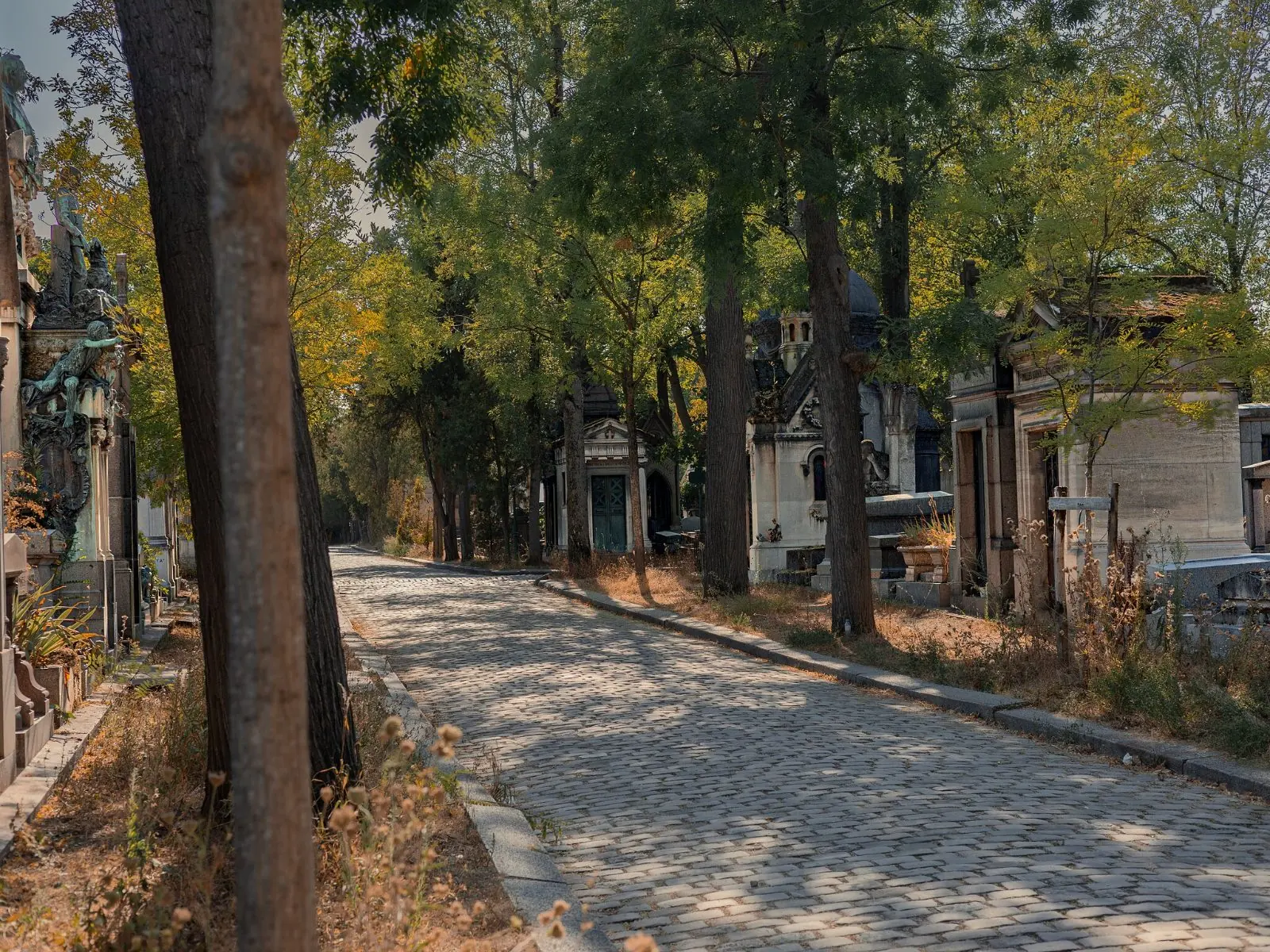
Between eight and nine on a weekday the cemetery above division 50 is effectively empty. You will pass groundsmen and the occasional person visiting a family grave, and otherwise nothing. The light at that hour is low and raking, which matters more here than it does at most sites: Brongniart designed this as a landscape garden with framed views and modelled ground, and nineteenth-century funerary sculpture is carved for shadow. At noon in June it all goes flat.
Coach groups begin arriving around ten. By eleven, in July and August, the paths around Jim Morrison in division 6 and Chopin in division 11 are genuinely congested — those are narrow spaces and a group of forty fills them. The upper divisions stay quiet much longer, which is another argument for entering at the Gambetta gate.
The second-best window is the last ninety minutes of a winter afternoon. It gets dark by half past four in December, the cemetery is nearly deserted, and the combination of bare trees and low sun over the vaults is the thing most photographers come here for. You will be walking against the clock, but that is not the worst way to see a cemetery.
The worst is a Sunday afternoon between May and September: latest opening, largest crowds, slowest paths.
How the crowds actually distribute
Three million visitors a year sounds like a permanent crush. It is not, because they concentrate almost entirely in about six places and about four hours.
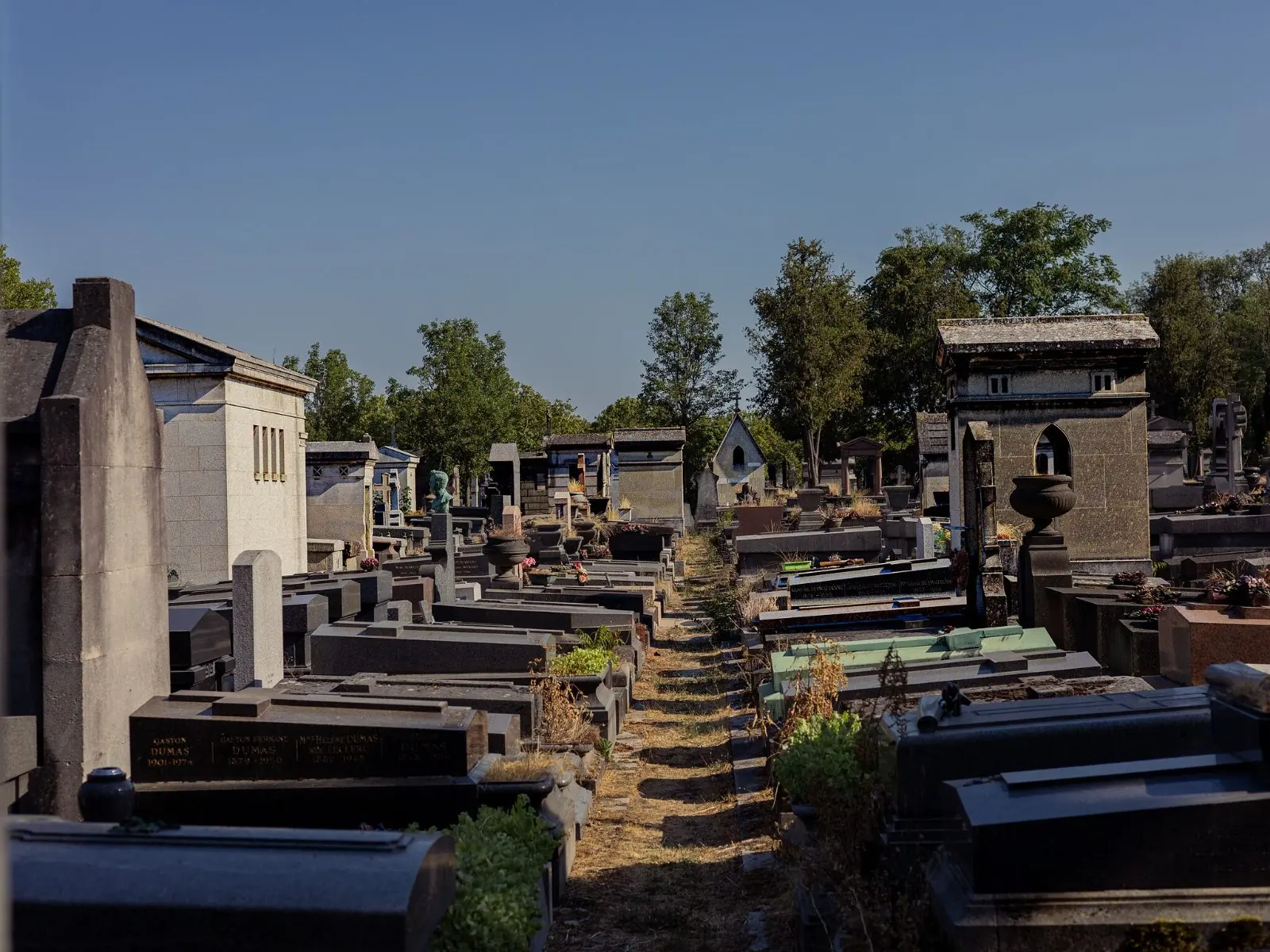
The pressure points are division 6 (Morrison), division 11 (Chopin), division 89 (Wilde), division 97 (Piaf), the columbarium in 87 and the main avenue between the gate and the roundabout. Everything else — which is to say roughly ninety per cent of forty-four hectares — is quiet at any hour of any day.
That has a useful consequence. If you arrive at eleven on a July Saturday and find the lower divisions unpleasant, the fix is not to leave; it is to walk two divisions in any direction. Ten minutes’ walk from Chopin, in ground with no famous name in it at all, you will be alone with better sculpture.
It also means that the famous-grave route and the enjoyable route are not the same route. If your priority is the place rather than the list, come at any hour you like and simply avoid the six.
The best time of year
Autumn, by some distance. The tree cover here is extraordinary — Père Lachaise is the largest green space inside Paris, and the planting is two hundred years old — and late October gives you the whole thing turning at once, with the light low all day. It is also the season in which the cemetery looks most like what it was designed to be.
Winter is bleak, quiet and arguably the most appropriate. Nothing is in leaf, the sightlines open up, and you can see the structure of the ground.
Spring is pleasant and increasingly busy. Summer is the busiest and the least rewarding: hard overhead light, dry paths, and every group in Paris.
Rain improves it in every season, and the cemetery does not close for it.
When it does close
Almost never — it opens every day of the year, including public holidays.
The exception is wind. The trees here are large and old, and the City of Paris closes the cemetery at short notice when it judges there is a risk of falling limbs. This happens a handful of times a year, usually in winter, and it is announced on the City’s own page rather than anywhere else. If you are planning a visit on a stormy day, check before you travel.
Individual gates also close for works from time to time. We keep the current position on our hours page, taken from the City and dated, but the City’s page is always the authority.
One more time, in one line
Weekday, first thing, autumn, in at Gambetta, out at the boulevard. That is the best two hours this cemetery has to offer, and it costs nothing.