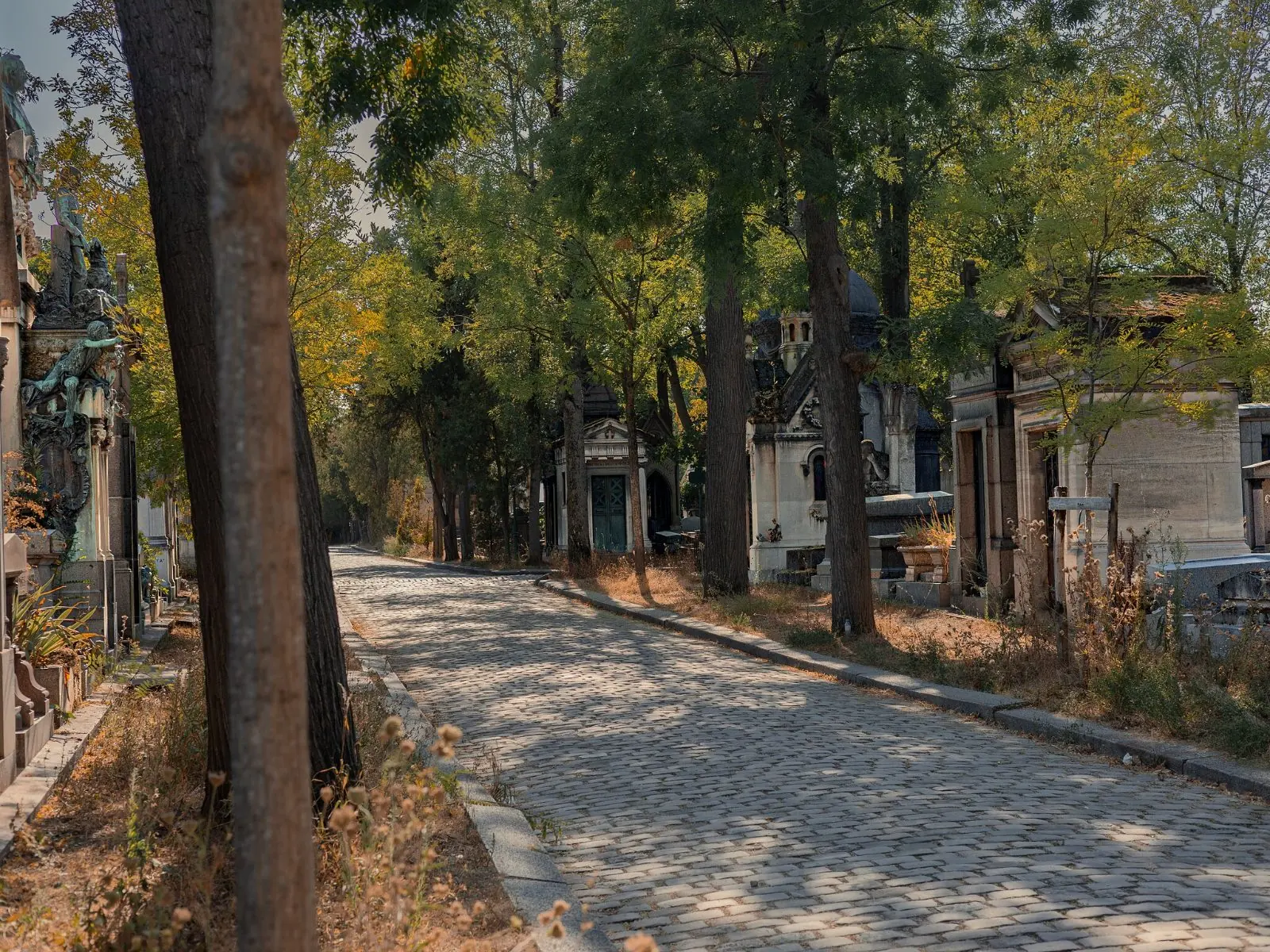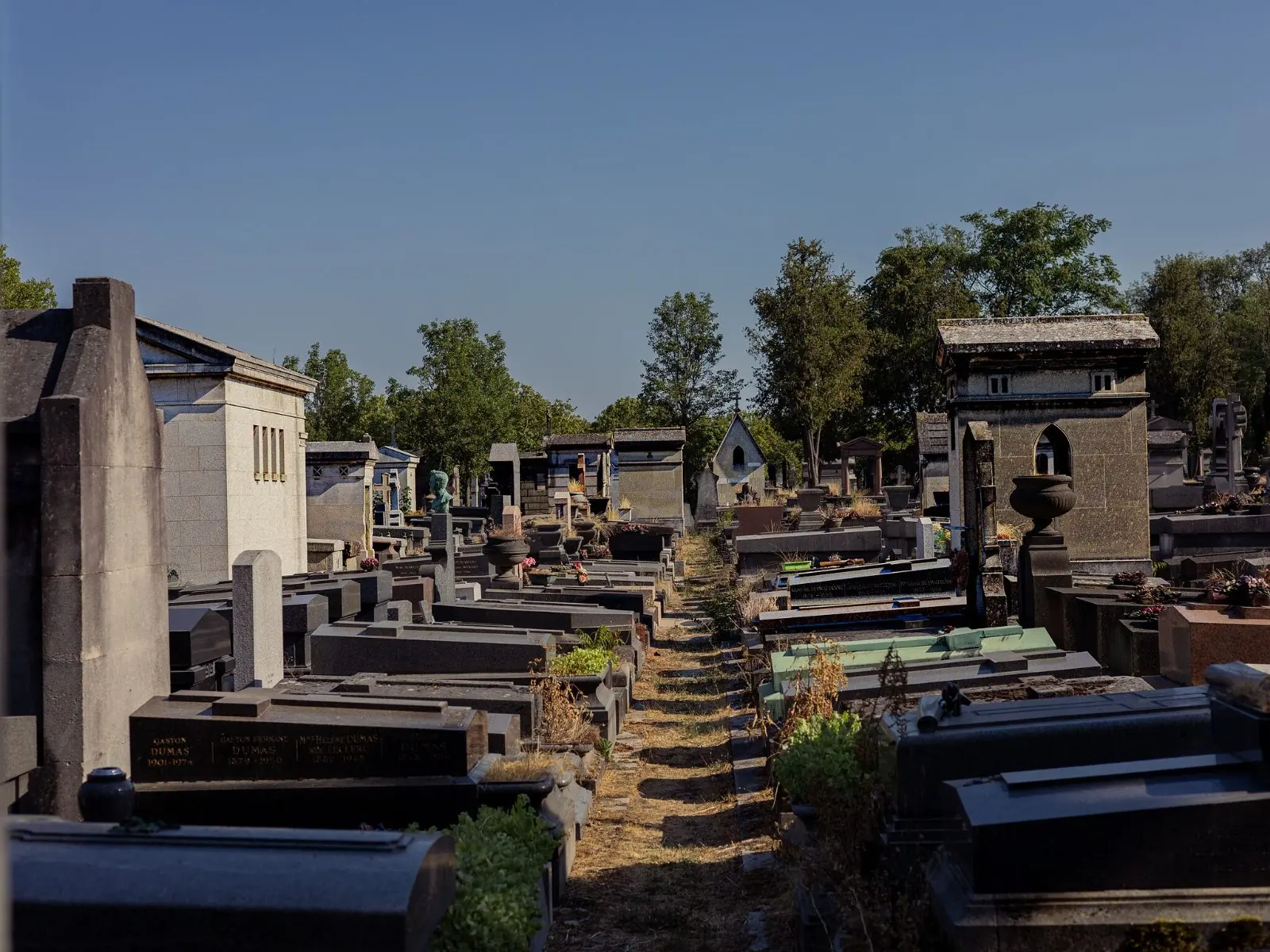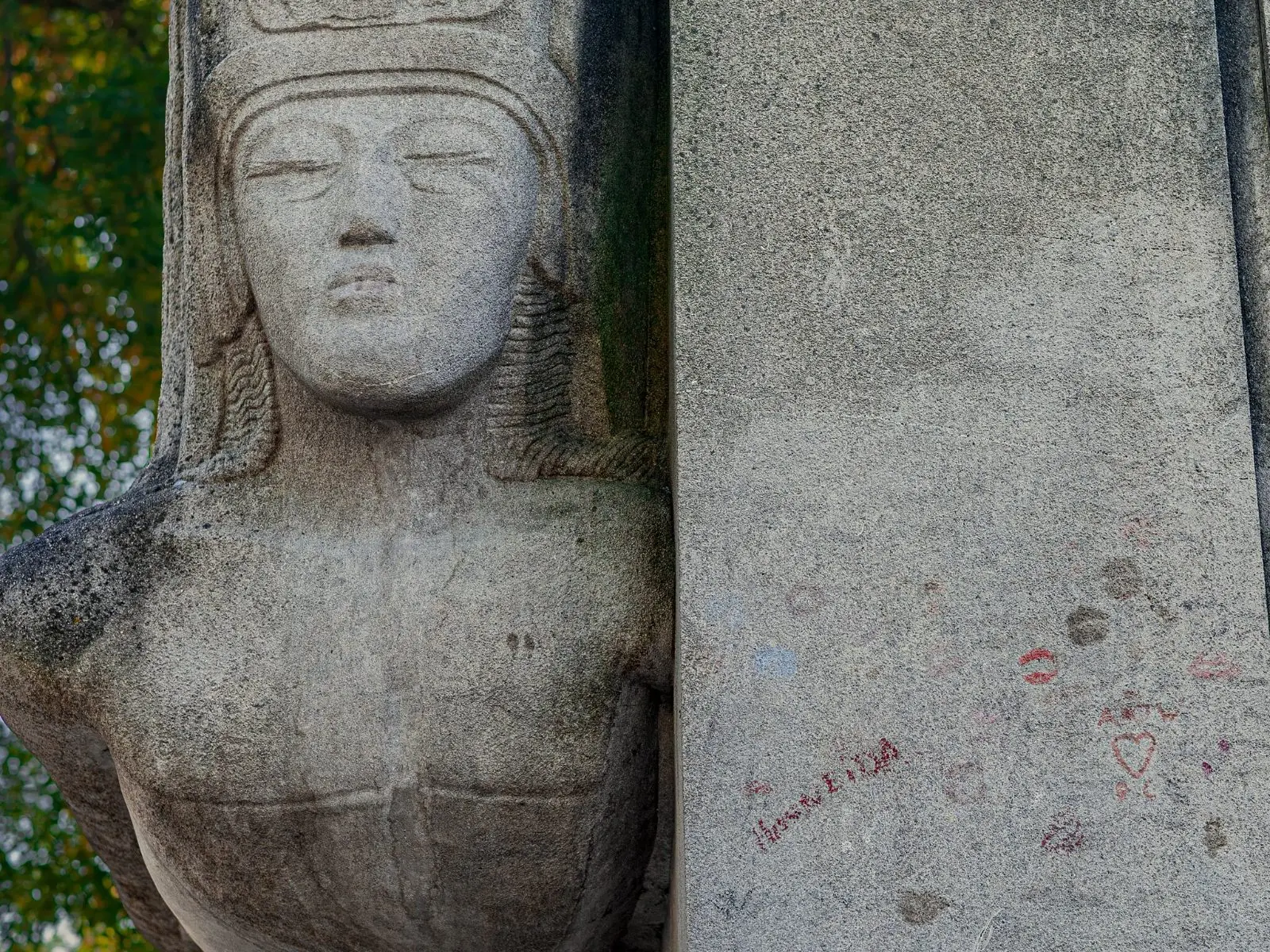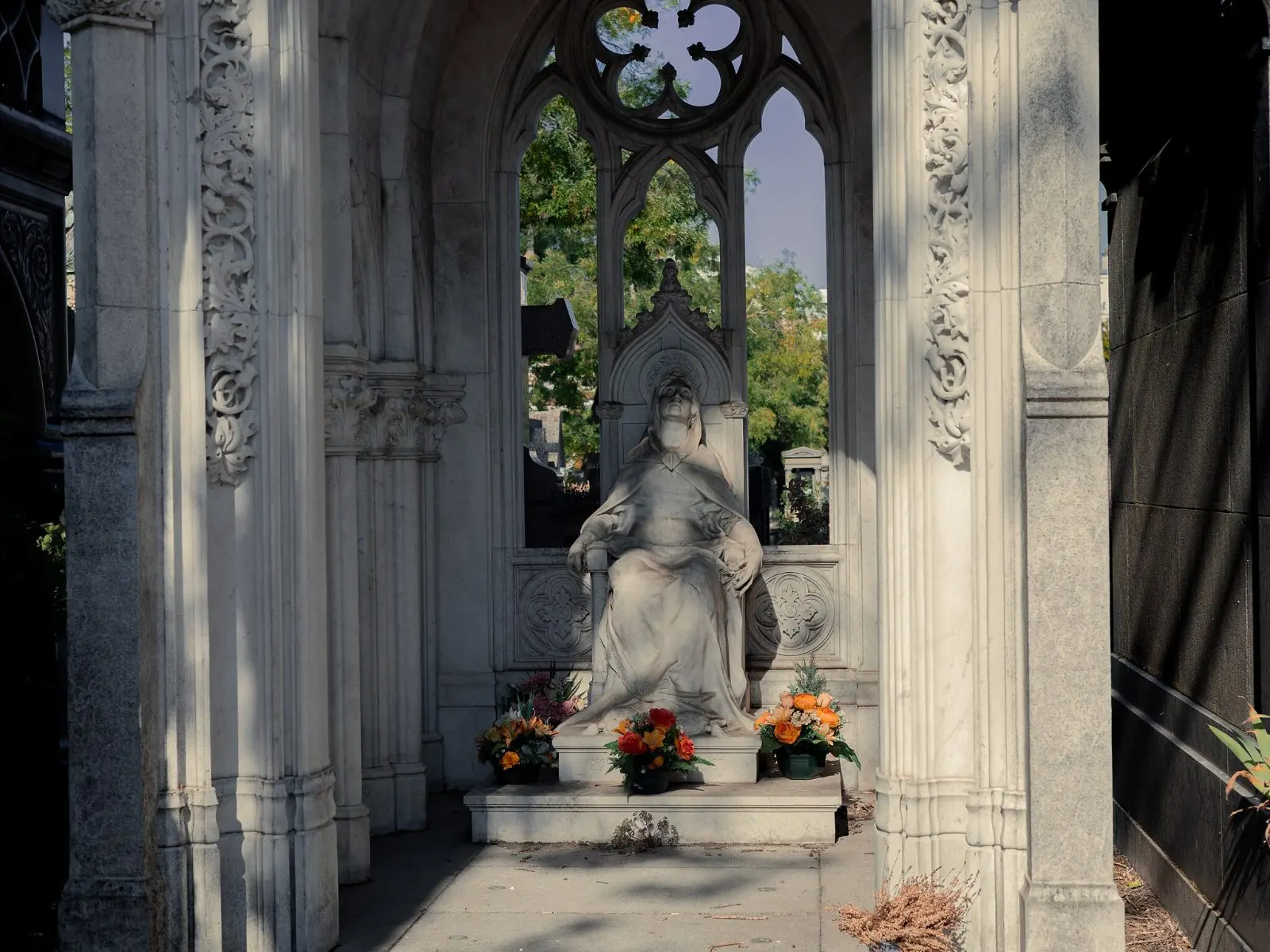
The best thing about Père Lachaise is not the famous graves. It is the eight hundred metres of anonymous ones between them, and the fact that almost every stone in that eight hundred metres is making a specific argument in a language that has since fallen out of use.
Nineteenth-century funerary sculpture was a vocabulary, and a commercial one: monument masons worked from pattern books, families chose from a catalogue, and every element carried an agreed meaning that any literate passer-by could read. Learn about a dozen of them and a walk here changes completely.
Torches, inverted
The commonest thing in the cemetery and the easiest to miss.
A torch turned downwards, usually in pairs flanking a door or a plaque. It means a life extinguished — the flame going out. Where the flame is still shown burning at the inverted torch’s head, the meaning flips: the soul continues after the body. That second version is a specifically Christian modification of a classical form, and you will see both within a few metres of each other.
The classical original is the genius of death, a winged youth leaning on a reversed torch, which turns up all over Roman funerary art. The nineteenth century took it wholesale, because the nineteenth century took everything from Rome.
The broken column
A column snapped off partway up, often with the broken section lying at its base.
It means a life cut short: someone who died young, or in their prime, or before their work was done. It is not a general symbol of death — putting one over an eighty-year-old would have been read as a mistake, or a joke.
Look at how high the break is. The convention was that the height of the column corresponded to the life, so a very low break is a child and a high one is a man interrupted in middle age. Pattern books offered them in several heights.
The draped urn
An urn with a cloth thrown over it, the single most-repeated motif in western funerary art after the cross.
The urn is classical — it holds ashes — and the drapery is the veil between life and death. In practice, by the 1830s, it had become the default respectable choice, the funerary equivalent of a black tie: chosen by people who wanted the monument to say nothing in particular about the person under it. When you see a whole row of them, you are looking at the middle of the market.
The ouroboros
A snake with its tail in its mouth, usually carved as a ring around a portrait medallion or a name.
Eternity, and the cyclical rather than linear kind — the thing that has no beginning and no end. It is one of the oldest symbols in the book, Egyptian by origin, and it arrived in the nineteenth century by way of alchemy and freemasonry. Its presence often, though not always, indicates a family with masonic connections, and if you see it alongside a set square, a compass or an all-seeing eye, it certainly does.
Poppies, and other flowers
Poppies mean sleep, and by extension eternal sleep. They pre-date the First World War associations entirely and mean nothing about soldiers.
Roses mean love, but count them and check the stage: a bud is a child, a partly open rose an adolescent, a full bloom an adult, and a rose with a broken stem is a life ended. Ivy means fidelity and attachment, because it clings. Wheat means a life brought to harvest — appropriate for the old, insulting for the young. Immortelles, the dried yellow everlasting flowers you still occasionally see, meant exactly what their name says and were the standard grave offering here for a century.
Hands
Two hands clasped is the most frequently misread carving in any cemetery.
It is usually taken as a couple reunited. Sometimes it is. But look at the cuffs: if one sleeve is a woman’s and one a man’s, it is a marriage; if both are the same, it is more likely friendship or a farewell rather than a union. And look at which hand is on top — the convention was that the hand doing the clasping belongs to the one who died first, welcoming the other.
A single hand pointing upward is the soul ascending. A single hand pointing downward is not damnation, which is the usual misreading, but God reaching down.
Books
An open book is a life laid out for judgement, or a record of good works, or — where it carries actual text — the Bible.
A closed book is a life completed. Where a book appears with a pen or a laurel, it is straightforwardly a claim about the profession of the person underneath, and Père Lachaise is full of these because Père Lachaise is full of writers.
Doors, and what they are doing
The single most affecting device in this cemetery, and the one nobody explains.
A great many of the family chapels here have a carved door on the front — sometimes closed, sometimes standing ajar, occasionally with a figure passing through it. The door is the threshold. Closed, it is finality; ajar, it is the passage open, and someone expected to follow.
Once you have seen it you will see it everywhere, and it culminates in Bartholomé’s Monument aux Morts at the roundabout, which is the whole idea rendered at scale: a line of naked figures of every age walking into a plain doorway cut into a wall of stone. No angels, no inscription, no consolation. It is the best sculpture here and it works entirely through this one convention.
Empty shoes, empty chairs
Rare and worth stopping for. An empty chair, a pair of small shoes, a cradle: these mark the death of a child, and they are the point at which the pattern-book vocabulary breaks down and a family said something in their own words.
Where to practise
Do not start with the famous graves. They are the worst place to learn this, because the monuments over famous people were usually commissioned by committees, decades late, from named sculptors, and they follow their own logic rather than the pattern books.
Start instead in divisions 49 to 56, on the slope above Balzac. That ground filled up through the 1830s to 1860s — the peak of the pattern-book trade — and it is dense with family chapels of exactly the middling sort where the vocabulary is used most fluently and most conventionally. Walk one path slowly and you will find inverted torches, draped urns, ouroboros, clasped hands and half a dozen carved doors inside fifty metres.
Then go and look at division 7 and the surrounding lower divisions, which filled thirty years earlier. The difference is immediately legible: less ornament, more Roman severity, sarcophagi rather than chapels. The 1810s were still building for the Empire; the 1850s were building for the Second Empire, and they are not the same taste at all.
Finally, walk up to division 87 and the columbarium. Cremation arrives in the 1880s, and with it a vocabulary problem: none of this symbolism was designed for a niche the size of a shoebox. Watching families solve that in miniature, over the following century, is the last chapter of the story.
Reading a tomb as a whole
Take any monument and ask three questions.
What did they want said about the person? Broken column, wheat, a bud rose — the vocabulary of the life.
What did they want said about themselves? A large chapel with a masonic ouroboros and a portrait medallion in bronze is a family making a claim about its own standing in the 1860s, and the size of the plot is part of the sentence.
What did they choose not to say? A draped urn and nothing else is a decision. So is Delacroix’s black sarcophagus in division 49, which the painter specified himself, stripped of every symbol available to him, in a cemetery of people competing to use them all.
That last question is the interesting one, and it is what makes Proust’s plain black slab and Sarah Bernhardt’s plain granite worth walking to. In a place this fluent, silence is the loudest thing you can carve.